
There is a distinction most drivers never make, and it costs them real money: maintenance and the record of maintenance are two separate assets.
The first one keeps the car running. The second one is what you actually get paid for — and it's the one people throw away. Nearly every high-stakes moment in owning a vehicle comes down to someone else evaluating your evidence: a buyer deciding what to offer, a warranty administrator deciding whether to approve a $6,000 engine, a judge deciding whether a car was a lemon. In all of those rooms, the same rule applies. An undocumented repair did not happen.
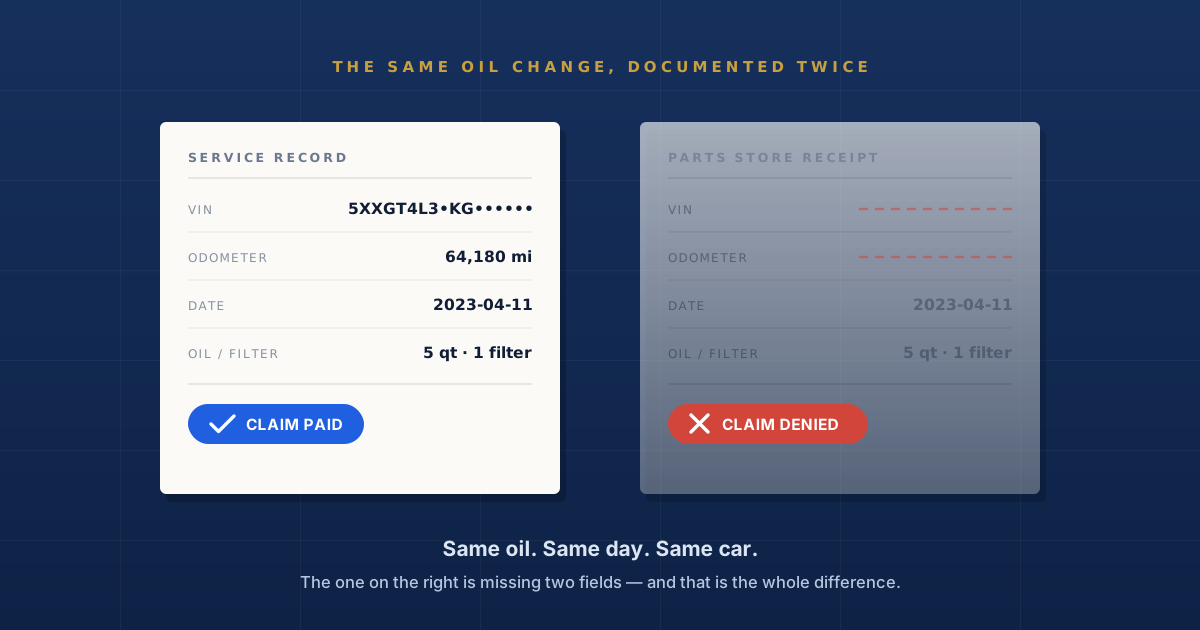
Both receipts document the same service. Only one of them is evidence.
The average vehicle on US roads is now 12.8 years old — the eighth straight annual record, according to S&P Global Mobility — and passenger cars alone average 14.5. Over that lifespan almost everything about a car degrades. The service record is the one component that only gets more valuable.
1. A documented car is a different product
The cleanest numbers come from the UK, where "full service history" is a standard listing field and therefore actually measurable. The used-car marketplace Motorway puts the premium for a complete history at up to 20% of vehicle value. The vehicle-data firm HPI estimates that missing records can take as much as 40% off an asking price. The commonly cited trade range is 10–20%.
Treat those as directional rather than precise — they're industry estimates, not controlled studies, and the US market has no equivalent standardised field.
The US mechanism is different but points the same way. Valuation here is condition-graded: Kelley Blue Book prices into four tiers (Fair, Good, Very Good, Excellent), Edmunds into five. That's where the money moves, and the practical difference between claiming Excellent and substantiating it is a folder of receipts. CARFAX explicitly folds reported service history into its value estimate.
The asymmetry is the part worth understanding. A buyer cannot verify that you changed the timing belt at 90,000 miles. They can only verify that you can prove it. Without proof, a rational buyer prices in the risk of the most expensive thing you might have skipped — which is exactly why the penalty for missing records is consistently estimated as larger than the premium for having them.
2. The warranty you paid for, when you need it
Jamie Rekasie's 2019 Kia Optima lost its engine at 80,000 miles, comfortably inside a 100,000-mile powertrain warranty. He had the paperwork: fourteen oil changes, two sets of brakes, two sets of tires.
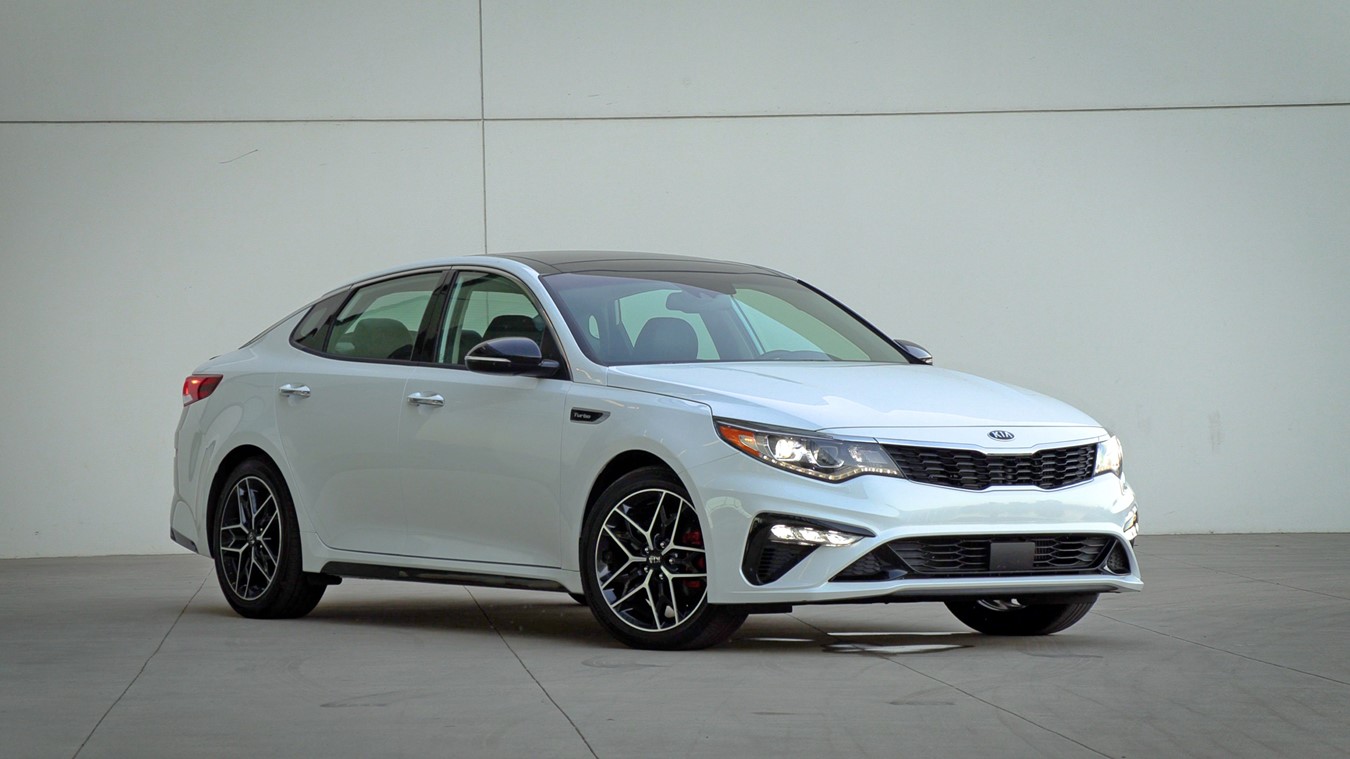
Jamie Rekasie's 2019 Kia Optima SX — the car Kia initially denied an engine claim on, over receipts that were missing a VIN and odometer reading.
Kia denied the claim. Not for missed maintenance — he plainly hadn't missed any. The stated reason was that the oil-change receipts didn't list the car's VIN or the odometer reading. A receipt from a parts store proves five quarts of oil were bought on a given day. It does not prove the oil went into that car at that mileage. Kia's position is that it approves owner-performed oil changes when the receipt shows four things: quantity of oil, an oil filter, the date, and vehicle mileage.
After CBS Pittsburgh started asking questions, Kia reversed and approved the engine "in the spirit of customer satisfaction." Michael Brooks of the Center for Auto Safety described the underlying pattern plainly: the first tactic is often to deny and hope the consumer goes away. Dozens of owners reported the same failure and the same denial.
That's the optimistic version, because Rekasie had records to argue with. In 2022 a Hyundai owner was refused an engine replacement outright for having no oil-change receipts at all. No reversal, and nothing to appeal with.
What the law actually protects
The Magnuson-Moss Warranty Act, enforced by the FTC, makes it illegal for a manufacturer or dealer to void your warranty because someone other than the dealer did the work, or because you fitted an aftermarket part. If they deny on those grounds, the burden is on them to prove the outside part or service caused the failure. The FTC sent warning letters to major companies over this in 2018.
That protection is real, and narrower than people think. It protects your choice of servicer. It does not relieve you of showing the car was maintained at all — and if you kept nothing, the manufacturer never has to reach the causation question. The FTC's own guidance is blunt: keep all service records and receipts regardless of who does the work.
The same logic now applies to EVs. Traction batteries carry a federal minimum of 8 years or 100,000 miles (10 years / 150,000 in California and the states following its standard), typically guaranteeing around 70% capacity retention. Those warranties are equally conditioned on required inspections and diagnostic history — with the added trap that some are structured as renewable one-year terms, each with conditions you have to meet to keep coverage alive.
3. The repairs you never have
Skipped maintenance is rarely a decision. It's a lapse — nobody knew the interval had passed. A log turns a vague intention into a dated, mileage-stamped fact, and that's where the arithmetic gets real. Each pair below is the same failure mode priced twice: once as scheduled work, once as the breakdown that follows from not doing it.
| Item | Scheduled service | If you skip it |
|---|---|---|
| Oil & filter change | $50–$130 | $4,500–$9,000 |
| Timing belt | $500–$2,000 | $3,000–$7,000 |
| Transmission fluid | $80–$290 | $1,500–$5,000 |
| Brake pads | $150–$350 | $1,000–$2,000 |
US independent-shop ranges, 2026. European and luxury vehicles sit at or above the top of each band.
The timing belt is the sharpest illustration. Roughly 70% of engines are interference designs, meaning the pistons and valves occupy the same space at different moments. When the belt breaks, they occupy it simultaneously. And a timing belt is a wear item with a published replacement interval and no symptoms before failure — it is detectable only by looking up when it was last done. That is a record-keeping problem, not a mechanical one.
Brakes escalate the same way on a smaller scale: pads are a few hundred dollars, but running them to the backing plate takes out rotors, calipers and sensors and turns the job into four figures. AAA puts average annual maintenance at $1,234 per vehicle, up 12% year over year, and separately estimates that 64 million Americans would need to borrow to cover an unexpected repair. Deferral isn't free financing — it's a loan at a terrible rate.
4. When the record becomes evidence
Every state's lemon law turns on some version of "a reasonable number of repair attempts within a rights period." In California that's two years or 24,000 miles. What proves it is the stack of repair orders — dates in the shop, the complaint in the owner's own words, the technician's findings, the mileage at each visit. Attorneys describe repair orders as the single most important evidence in such a case.
Here's the part almost nobody knows: you are entitled to a written repair order at every visit, including visits where nothing was repaired and the car was only inspected or test-driven. Those "no fault found" orders are frequently the most valuable documents in the file, because they establish that the manufacturer had notice of the problem and a chance to fix it. Accept a verbal "we couldn't reproduce it" and drive away, and you've silently erased a repair attempt.
Maintenance records also underpin diminished value claims — recovering the resale value a car loses after being repaired following a collision. Because the claim is the difference between what the vehicle was worth before and after, the burden is on you to establish the "before": pre-accident photos, maintenance history, any pre-loss appraisal or trade-in offer. Insurers routinely open with a low offer or a denial, and documentation is what moves them.
5. The recall you never heard about
CARFAX counted 58.1 million US vehicles with unresolved safety recalls as of January 2025 — roughly one in five registered vehicles. The repairs are free. The problem is purely one of tracking, and it decays sharply with age: recall completion runs around 83% on new vehicles, falls to about 44% for vehicles five to ten years old, and collapses to roughly 15% past ten years.
The reason is mundane. Notices are mailed to the registered owner of record, and second and third owners frequently never receive them. A recall follows the VIN; the mail follows the last address the manufacturer had. A maintenance history that carries the VIN is often the only thing that reconnects them.
On wear items, NHTSA's crash causation survey attributed the critical pre-crash reason to the driver in 94% of crashes — a figure widely misread as meaning vehicle condition doesn't matter. It doesn't mean that: "critical reason" is the last event in the causal chain, not the whole chain. The same survey found 9% of crashes involved a vehicle with tire problems in the pre-crash phase, and vehicles are markedly more likely to have tire problems when tires are underinflated or below adequate tread depth. Both are schedule items.
6. And the small stuff, continuously
The Department of Energy's fueleconomy.gov quantifies the everyday version. Fixing a serious maintenance fault — their example is a failed oxygen sensor — can improve fuel economy by as much as 40%. Keeping tires at the correct pressure is worth about 0.6% on average and up to 3%; every 1 psi below spec, averaged across all four tires, costs roughly 0.2%. Using the manufacturer's recommended oil grade adds another 1–2%.
None of those are dramatic on their own, which is precisely why they get skipped. They're recovered by a schedule, not by attention.
Anatomy of a record that holds up
Every field below exists because someone's claim was rejected for lacking it. A record carrying all seven survives a warranty review, a lemon-law discovery request and a buyer's inspection equally.
- VIN. Ties the work to this vehicle. The most common defect in owner-performed records, and exactly what sank the Optima claim. Write it on the receipt in pen at the counter.
- Odometer reading. Ties the work to an interval. Warranty schedules and lemon-law rights periods are denominated in miles. A date alone proves something happened in March, not that you met a 7,500-mile interval.
- Date. Establishes sequence — that the service preceded the failure, and fell inside the coverage period.
- Parts and quantities. Proves the work was actually possible. Kia's stated requirement is quantity of oil and a filter; a receipt for five quarts and no filter documents an incomplete service.
- Who performed it. Can't be used to void coverage under Magnuson-Moss — it's there to identify who's accountable if the work was done badly.
- The complaint, in your own words. On shop visits: ask for the written order every time, including the ones where nothing was found.
- A photo of the receipt. Thermal paper fades — a glovebox receipt can be blank within a couple of years. A record that has to survive a 10-year, 100,000-mile warranty must outlive its own ink.
Two habits matter as much as the fields. Keep the records outside the car — a glovebox folder is destroyed by precisely the events (theft, fire, a total loss) where proving the car's prior condition matters most. And keep them transferable, because the resale premium only materialises if the history can be handed to a buyer intact and legible. A shoebox of faded receipts and a dealer's internal system both fail that test, for opposite reasons.
None of this is difficult. It's just the kind of thing nobody does until the first time it costs them an engine.