
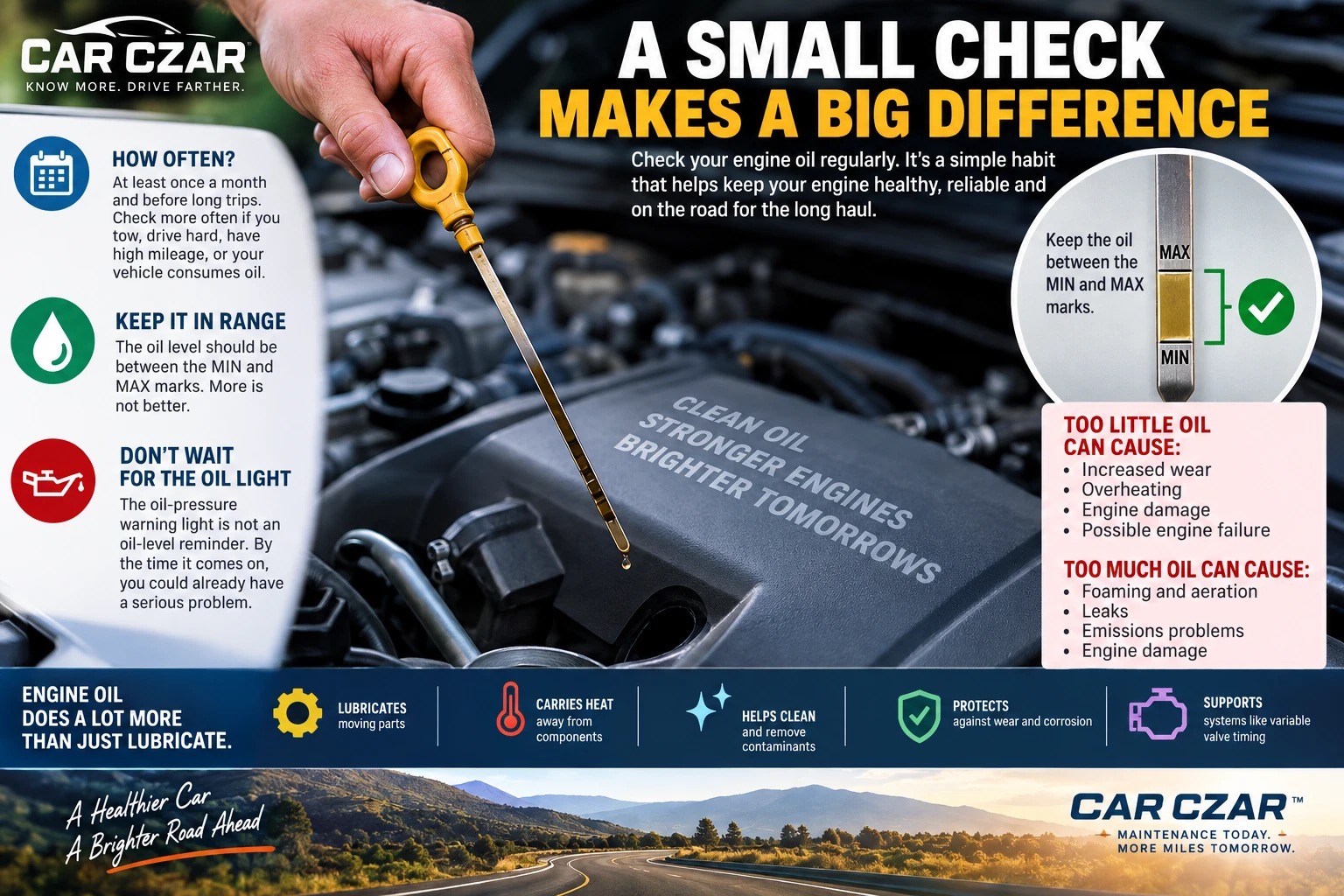
You should check your engine oil at least once a month and before a long trip. Some vehicle manufacturers recommend checking it even more frequently — sometimes every time you refuel.
If your vehicle consumes oil, has higher mileage, tows heavy loads, is driven hard, or operates under severe conditions, checking the oil more frequently is a smart precaution.
Checking your engine oil takes only a few minutes, but it can help prevent accelerated engine wear, overheating, lubrication problems, and potentially expensive engine damage.
There is also an important distinction many vehicle owners don't realize:
Changing your oil on schedule does not eliminate the need to check the oil level between oil changes. Your oil-change reminder tells you when the oil should be replaced. It does not necessarily tell you whether your engine still has the correct amount of oil.
What do vehicle manufacturers recommend?
There is no single oil-check interval that applies to every vehicle — manufacturer recommendations vary.
Honda recommends checking the engine oil level every time you refuel on vehicles such as the Accord, and instructs owners to keep the oil between the upper and lower marks on the dipstick. (Honda Owner Information)
Ford recommends checking engine oil monthly during normal use, and at every fuel fill-up under severe operating conditions such as high engine speeds and heavy engine loads. (Ford Owner Manuals)
Toyota also emphasizes regular oil-level checks and warns that failing to maintain sufficient engine oil can cause serious engine problems. (Toyota Owners Manuals)
Car Czar's recommendation: for most drivers, check your engine oil at least once a month and before long trips. Consider checking it more frequently if your vehicle:
- consumes oil between oil changes;
- has higher mileage;
- has a known oil leak;
- regularly tows or carries heavy loads;
- operates at high RPM or under heavy engine loads;
- is driven aggressively or on a track;
- has recently shown an unexplained change in oil level.
Always follow your vehicle manufacturer's specific procedure and recommendations when they differ from this general guidance.
Why is engine oil level so important?
Engine oil performs several critical jobs inside your engine. It helps lubricate moving components, reduce friction and wear, carry heat away from critical parts, suspend contaminants, protect internal surfaces against corrosion, assist with sealing between piston rings and cylinder walls, and operate certain hydraulic systems, including some variable valve timing systems.
One of oil's most important jobs is maintaining a microscopic lubricating film between moving metal surfaces — that film helps prevent direct metal-to-metal contact. Research in lubrication and bearing design has shown that inadequate lubricant supply, often called lubricant starvation, can reduce the thickness of this protective oil film. NASA lubrication research has examined the relationship between lubricant-film thickness, bearing performance, and bearing life. (NASA Technical Reports Server, NASA Technical Reports Server)
In simple terms: less available lubrication can mean less protection, increased friction, higher temperatures, and faster wear. That's why maintaining the correct oil level is about much more than simply having "some oil" in the engine.
What happens if your engine oil gets too low?
When your engine is running, the oil pump draws oil from the pan and circulates it through passages to bearings, camshafts, pistons, and other components requiring lubrication. If the available oil supply becomes too low, the engine may eventually have difficulty maintaining proper lubrication.
The progression can look like this: low oil level → inadequate lubrication → increased friction → increased heat → accelerated wear → component damage → possible engine failure. How quickly damage occurs depends on how severe the condition becomes.
Honda warns that operating an engine with low oil pressure can cause serious mechanical damage very quickly, and instructs drivers to stop safely, shut off the engine, and investigate the condition. A low-oil-pressure warning should never be treated as a routine maintenance reminder.
Oil level and oil pressure are not the same thing
This is one of the most important distinctions for vehicle owners to understand.
Oil level tells you how much oil is available in the engine, typically measured with a dipstick or an electronic oil-level sensor.
Oil pressure tells you whether the engine's lubrication system is successfully circulating oil under pressure.
The two are related, but they are not interchangeable. A vehicle's oil level can gradually decline without immediately triggering an oil-pressure warning. Likewise, an engine can contain the proper quantity of oil and still develop an oil-pressure problem because of an oil pump issue, an internal engine problem, excessive wear, an oil-system restriction, or another mechanical condition.
Don't wait for the oil warning light
Many drivers assume the red oil-can warning light will tell them when they need to add oil. That can be a dangerous assumption — the oil-pressure warning light is primarily designed to alert you to a lubrication-pressure problem, not to act as your routine oil-level reminder. By the time an engine experiences inadequate oil pressure, the situation may already require immediate attention.
That's why physically checking the oil level — or using the vehicle's manufacturer-provided electronic oil-level system — matters. Routine oil checks are preventative maintenance. A low-oil-pressure warning can be an emergency.
Keep your oil between MIN and MAX
The MIN and MAX marks on an oil dipstick represent the manufacturer's acceptable operating range. They do not mean MAX = good and MIN = empty — an engine still contains substantial oil when the level reaches the lower mark. The goal is to keep the oil within the manufacturer's specified range: don't let it drop below the minimum mark, but don't assume adding oil above the maximum mark provides extra protection.
Can you put too much oil in an engine?
Yes — more oil is not necessarily better. Honda specifically warns owners not to fill engine oil above the upper mark, because overfilling can contribute to oil leaks and engine damage.
If the oil level becomes excessively high, rotating internal components may interact with the oil and introduce air into it — a process often called aeration or foaming. Aerated oil does not behave the same way as a solid column of liquid and may interfere with consistent lubrication. Excessive oil can also contribute to:
- oil leaks;
- crankcase ventilation problems;
- increased oil consumption;
- oil entering the intake system;
- emissions-related problems;
- engine damage.
The lesson is simple: the goal isn't maximum oil, it's the correct oil level.
Engines can consume oil between oil changes
Engines can consume some oil during normal operation. Oil helps lubricate pistons, piston rings, and cylinder walls — a thin film remains on the cylinder walls as the pistons move, and some of that oil may eventually enter the combustion process and be burned. Toyota explains this process in its owner documentation and notes that driving conditions can affect oil consumption.
Oil consumption may vary depending on engine design, mileage, driving style, engine RPM and load, operating temperature, piston and ring condition, turbocharger condition, oil viscosity, leaks, and environmental conditions.
The maintenance principle that follows: your engine may use oil even though it isn't time for an oil change yet.
Why long oil-change intervals make oil checks more important
Modern vehicles can have relatively long oil-change intervals. Imagine a vehicle with a 10,000-mile oil-change interval, and an engine that consumes one quart of oil every 2,500 miles — over 10,000 miles, that could amount to roughly four quarts. The oil-life monitor might still be functioning exactly as intended, determining when the oil should be changed, but that doesn't necessarily mean the engine still has the correct quantity of oil.
This is why vehicle owners should understand the difference between three separate systems:
| System | What it tells you |
|---|---|
| Oil level | Do I have enough oil? |
| Oil pressure | Is oil circulating properly? |
| Oil-life monitor | When should the oil be changed? |
These systems answer different questions. An oil-life monitor should not automatically be treated as a substitute for checking oil level.
Can your engine oil level actually increase?
Surprisingly, yes. If you haven't added oil but the measured oil level is rising, that does not mean your engine somehow created more oil — in some circumstances, fuel or moisture can contaminate and dilute the engine oil. Ford notes that operating patterns such as repeated short trips, prolonged low-speed operation, and extended idling may contribute to oil dilution in certain applications.
If your engine oil level begins rising unexpectedly, particularly if the oil smells strongly of fuel or behaves differently than normal, the condition may deserve further investigation.
How to check your engine oil
Your owner's manual should always take priority, because procedures vary by vehicle — some newer vehicles no longer use a conventional dipstick and instead measure oil level electronically. For vehicles with a traditional dipstick, the basic process is generally:
- Park the vehicle on level ground.
- Shut off the engine.
- Wait the amount of time specified by the manufacturer.
- Remove the dipstick.
- Wipe it clean.
- Insert the dipstick fully again.
- Remove it and read the level.
- Confirm that the oil is between the MIN and MAX marks.
- Add the correct manufacturer-specified oil if necessary.
- Add oil gradually and recheck the level to avoid overfilling.
Different manufacturers specify different oil-checking conditions — some require a warm engine followed by a short waiting period, others may specify different procedures. Always use the procedure in your owner's manual.
How often should you check oil on a high-mileage vehicle?
High-mileage vehicles can benefit from more frequent oil-level monitoring. Age or mileage alone doesn't necessarily mean an engine will consume excessive oil, but wear, seals, leaks, and overall engine condition can influence consumption.
If your vehicle requires oil between changes, record the vehicle mileage, the oil level, the date checked, the amount of oil added, and the mileage at the next check. For example:
- 65,200 miles — oil at halfway mark
- 66,100 miles — added ½ quart
- 67,000 miles — oil at halfway mark again
That gives you an oil-consumption trend rather than isolated observations — changes in the trend can be valuable diagnostic information.
What should you do if your oil is constantly low?
If your oil repeatedly drops between checks, don't simply continue adding oil indefinitely without trying to understand why. Possible causes include external oil leaks, worn engine seals, worn piston rings, valve-related oil consumption, turbocharger problems, crankcase ventilation problems, and other internal engine conditions.
Record how much oil you add and how far you drive between additions. "1 quart every 4,000 miles" is much more useful information to a technician than simply saying "my car uses oil" — tracking the trend can also alert you when consumption begins increasing.
Frequently asked questions
How often should I check my engine oil?
For most drivers, checking engine oil at least once a month and before long trips is a reasonable general guideline. Some manufacturers recommend checking every time you refuel. Vehicles that consume oil or operate under severe conditions should be checked more frequently.
Should I check my oil even if my car tells me when to change it?
Yes. An oil-life monitor helps determine when the oil should be changed — it does not necessarily tell you whether the engine currently contains the correct quantity of oil. Oil level and oil life are two different measurements.
Should engine oil always be exactly at the MAX line?
Not necessarily. The important thing is that the level remains within the manufacturer's acceptable range. Don't allow the level to fall below MIN, and don't overfill above MAX.
Does the oil warning light mean my oil level is low?
Not necessarily. An oil warning light commonly relates to oil pressure, not simply oil quantity. Low oil level can eventually contribute to low oil pressure, but the warning light should not be used as your routine reminder to check the oil.
Can low engine oil ruin an engine?
Yes. Insufficient lubrication can increase friction, heat, and wear. If the engine loses adequate oil pressure, serious mechanical damage can occur very quickly.
Is too much engine oil bad?
Yes. Overfilling can contribute to leaks, aerated oil, crankcase ventilation problems, and possible engine damage. Keep the oil inside the manufacturer's specified operating range.
Does an engine normally use some oil?
It can. Some oil consumption can occur during normal engine operation, and the amount varies considerably based on engine design, mileage, driving conditions, engine load, and mechanical condition. A sudden increase in oil consumption deserves attention.
A small check can prevent a big problem
Engine oil is one of the most important protections your engine has, yet checking the oil level is one of the simplest maintenance tasks a vehicle owner can perform. Remember three basic rules: check it regularly, keep it within the manufacturer's specified range, and don't wait for the oil-pressure warning light.
A few minutes spent checking your engine oil today could help prevent a much more expensive repair later.
Car Czar: know more about your car
Car Czar is built around a simple idea: vehicle owners should have clear, relevant, and timely information about their cars. Vehicle maintenance shouldn't simply mean receiving an oil-change reminder every few months — a smarter approach is to understand your vehicle over time: maintenance performed, mileage, repairs, fluid levels, warning signs, and changes in behavior.
Tracking engine oil is a perfect example. Instead of simply recording an oil change, Car Czar can help vehicle owners think in terms of when the oil was last checked, whether the vehicle has required oil between changes, whether oil consumption is increasing, and whether that change indicates a developing problem.
Better information can help vehicle owners maintain their cars more effectively, identify problems earlier, reduce unexpected repair costs, and preserve their vehicle's long-term value.
Car Czar — Know More. Drive Farther.
Sources and further reading
- Honda Owner Information — engine oil level checks, adding engine oil, and low-oil-pressure warnings. techinfo.honda.com
- Ford Owner Manuals — owner maintenance checks, engine oil monitoring, and severe-use guidance. fordservicecontent.com
- Toyota Owners Manuals — engine oil maintenance, oil consumption, and owner maintenance information. toyota.com/owners
- NASA Technical Reports Server — Bearing Elastohydrodynamic Lubrication: A Complex Calculation Made Simple. ntrs.nasa.gov
- NASA Technical Reports Server — Lubricant Effects on Bearing Life. ntrs.nasa.gov
Vehicle specifications, oil-checking procedures, oil grades, and acceptable oil-consumption limits vary by year, make, model, and engine. Always consult your vehicle's owner's manual for the manufacturer's specific requirements.