
Walk through any tire shop and you will see it: a rack of bright green valve caps and a sign offering to fill your tires with nitrogen. Better pressure retention, longer tire life, better fuel economy. Some of that is true. Most of the benefit comes from something you can do yourself for free.
What nitrogen actually does, and what it doesn't
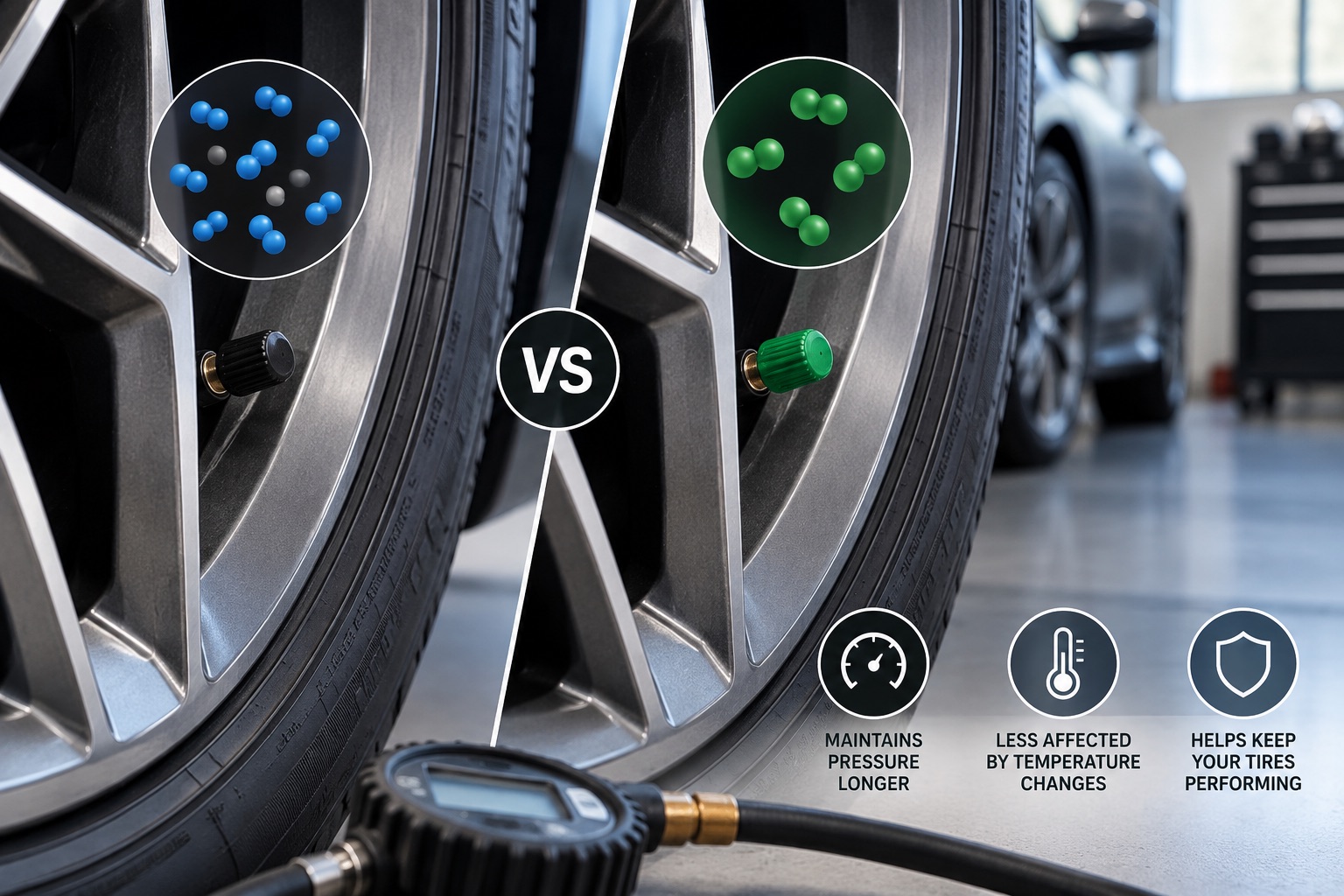
Start with the thing nobody selling nitrogen leads with: the air already in your tires is about 78% nitrogen. A "nitrogen fill" is really a purity upgrade, typically to around 95%, achieved by running shop air through a membrane that strips out oxygen and water vapor.
Two real properties follow. Nitrogen molecules are slightly larger than oxygen molecules, so they migrate through rubber more slowly — every tire leaks through its own sidewall, and nitrogen leaks marginally less. And the gas is dry, where shop air carries water vapor that can corrode wheels and valve hardware from the inside.
How much is that worth in a passenger car? Consumer Reports filled one tire from each of 31 all-season models with air and another with 95%-pure nitrogen, set both to 30 psi, and left them for a year. The air tires lost 3.5 psi on average; the nitrogen tires lost 2.2 psi. That is a real difference — roughly a 37% reduction in leak-down — and also, in absolute terms, 1.3 psi over twelve months.
Tire makers say much the same. Continental allows that nitrogen "may marginally contribute to reductions in tire inflation loss by permeation," then states plainly that for normal consumer use it is not required — and that it does nothing about the leaks that actually strand people: punctures, bad valve cores, bead leaks at the rim.
Where to get it, and whether you can mix it with air
Tire chains and dealership service departments generally have a generator on site. Standalone fills run a few dollars per tire; converting a set of air-filled tires — which requires purging each one several times to raise purity — is quoted between roughly $70 and $175. Costco installs tires with nitrogen at no charge and keeps self-serve nitrogen inflators outside many tire centers for members, the cheapest ongoing source most drivers have (SlashGear).
Can you mix them? Yes — no hazard, no damage. You are adding a gas that is 78% nitrogen to a tire that is already mostly nitrogen. Consumer Reports puts it bluntly: no harm in topping off with regular air, but it defeats the purpose. Each shot dilutes purity and drags you back toward ordinary atmosphere.
That is the practical trap. A correct 32 psi of shop air is far better for your tires than a stubborn 26 psi of nitrogen you refused to dilute. Fill it with air and re-purge later.
Why the cap is green
The green valve cap is a convention, not a regulation. It exists so a technician knows at a glance that this tire was filled from a nitrogen line and should be topped off from one. Some versions add an inner seal as a secondary barrier against a leaking valve core.
What the cap does not do is hold pressure. The valve core is the seal; the cap keeps dirt out of it and communicates a service instruction. A green cap on a tire topped with station air for two years means nothing at all.
What holding pressure is actually worth
Set nitrogen aside, because the underlying benefit — a tire that holds its correct pressure — is genuinely valuable, and it is why the pitch works. An underinflated tire flexes more, runs hotter, and wears its shoulders faster than its center. Federal rules treat 25% below the placard pressure as "significantly underinflated" — the point at which your TPMS light is required to come on, under FMVSS No. 138. That light is a late warning, not an early one: on a 35 psi placard it stays dark until you are near 26 psi, and you have been losing tread life and fuel economy the whole way down.
On tire life, chronic underinflation of about 10 psi is commonly cited as costing up to a quarter of tread life, while NHTSA credits proper inflation with adding several thousand miles to the average tire. On fuel economy the numbers are smaller and better pinned down: the Department of Energy's fueleconomy.gov puts the gain from proper inflation at 0.6% on average and up to 3% in the worst cases — roughly 0.2% per psi of average underinflation across all four tires.
Apply that honestly to nitrogen. A 1.3 psi advantage accumulated over a full year is worth roughly a quarter of a percent in fuel economy — a rounding error against a tank of gas. Nitrogen's tire-life and mileage benefits are real only in the sense that they are the benefits of correct pressure, which nitrogen lets you drift away from slightly more slowly.
Temperature moves your pressure more than nitrogen ever will
Here is the effect that dwarfs permeation. Tire pressure rises and falls with ambient temperature at roughly 1 to 2 psi per 10°F, a rule of thumb published by the U.S. Tire Manufacturers Association. A tire set to 35 psi on a 70°F afternoon can read near 30 psi after a 20°F night — a bigger swing overnight than a full year of permeation difference between the gases.
Nitrogen does not exempt you: gas pressure tracks temperature regardless of which gas it is. The honest claim is narrower — dry gas behaves more predictably because no water vapor is changing phase. That is why aviation and racing use it, and not why your commuter car would.
So check pressures cold — before driving, or after the car has sat three hours — because a warm tire reads high and leaves you underinflated once it cools. And expect to add air every fall, whatever is in the tire.
How often to check, and what to do about it
Once a month, and before any long trip. That is the recommendation from NHTSA, USTMA, and every tire manufacturer, and it does not change based on what gas you paid for. Include the spare. Use the placard inside the driver's door jamb, not the maximum molded into the sidewall — those are different numbers, and the sidewall figure is not a target.
The honest summary: nitrogen works, slightly. Take it when it is free and bundled with a tire purchase. It is not worth $100 for a conversion, and it is never worth skipping a top-off over. Check monthly with a decent gauge and you will beat a nitrogen-filled tire that gets looked at twice a year, by a wide margin.
The catch is remembering — monthly is exactly the interval people intend to keep and don't, which is the part Car Czar is built for. Put a recurring tire-pressure check on your vehicle alongside the oil changes and rotations, and let the reminder do the work the green cap can't.
Sources
- Consumer Reports — Should You Use Nitrogen in Your Car Tires? (31-model, 12-month leak-down test: 3.5 psi air vs. 2.2 psi nitrogen)
- Continental Tire — Nitrogen vs. Air: What Is Right For My Tire?
- U.S. Department of Energy / EPA, fueleconomy.gov — Keeping Your Car in Shape (0.6% average, up to 3%; ~0.2% per psi)
- NHTSA — Tires & TireWise (monthly cold checks, tire life, fuel savings)
- eCFR — 49 CFR 571.138, FMVSS No. 138: Tire Pressure Monitoring Systems (25%-below-placard warning threshold)
- U.S. Tire Manufacturers Association — Tire Care Essentials (1–2 psi per 10°F; monthly cold checks)
- SlashGear — Does Costco Give You Free Nitrogen for Tires? (availability and typical conversion pricing)