Car Recalls Are Changing: Software, EVs and Over-the-Air Repairs
Millions of recalled vehicles now get some or all of their fix as a software update.
For a long time, a safety recall had one familiar shape.
A letter arrived. You called the dealer. Someone replaced a part.
That path still exists. It is no longer the only one. NHTSA’s 2025 recall report counts millions of vehicles each year whose remedy is delivered partly or fully as an over-the-air software update, and it separately tracks recalls of electric-vehicle components on pure electric and hybrid vehicles.[1]
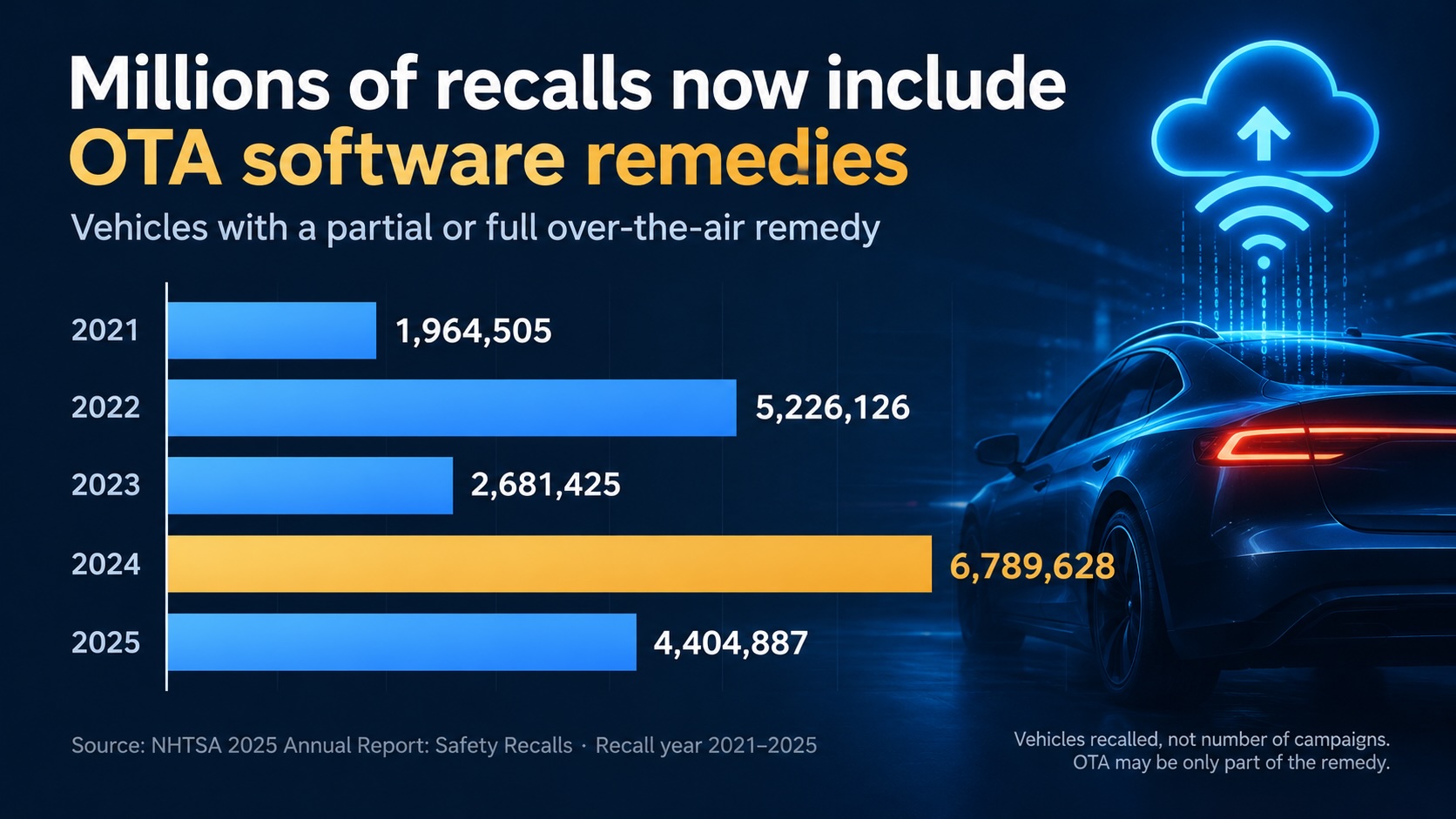
Millions of recalled vehicles now include a software remedy
NHTSA counts recalled vehicles whose remedy was partially or fully an over-the-air (OTA) update, by the year of the recall.[1]
Recalled vehicles with an over-the-air remedy
By recall year, partial or full OTA remedy. Totals at right.
TeslaAll other manufacturers
20211,964,505
20225,226,126
20232,681,425
20246,789,628
20254,404,887
Vehicles recalled, not number of campaigns. Source: NHTSA 2025 Annual Report: Safety Recalls.[1]
Across those five years, that is more than 21 million recalled vehicles with a software remedy.[1]
The total swings from year to year because one campaign can cover a huge number of vehicles. In 2024, Tesla alone accounted for 5,098,363 of the 6,789,628 vehicles in the OTA total. In 2025, the lead changed hands: Ford accounted for 2,365,332, Volvo for 837,771 and Tesla for 679,242.[1]
Tesla still accounts for the majority over the full period, about 12.1 million of the 21.1 million. But the list is no longer a one-brand story. NHTSA’s 2021–2025 table also includes General Motors, Mercedes-Benz, FCA, BMW, Hyundai, Kia, Rivian, Lucid, Nissan, Polestar and others.[1]
Your car's history. All in one place.
Maintenance
Service Records
Expenses
Reminders
Know what's been done, what's coming next, and how much your car is costing you.
Free to join • No credit card • Built for any vehicle
“Partially or fully” matters. An over-the-air recall does not always mean the whole fix happens in the driveway. Some remedies combine software with other work. Either way, the owner still needs to know whether the remedy actually reached that specific vehicle.
EV-specific recalls are a different count
NHTSA also charts recalls of EV-specific components on pure electric and hybrid vehicles. That is not “every recall of a car that has a battery.” A brake recall on a hybrid that has nothing to do with the electric system is outside this chart. A battery, charging, or other EV-specific component is inside it.[1]
The report labels how many vehicles those recalls covered:
Vehicles in EV-specific recalls
By recall year. Pure electric and hybrid vehicles, EV-specific components only.
2021150,364
20221,279,897
2023428,394
20242,481,247
20251,027,524
Vehicles recalled, not a rate per EV on the road. Source: NHTSA 2025 Annual Report: Safety Recalls.[1]
Those populations are not a straight line, and they are not a risk rate. The number of electric and hybrid vehicles on the road grew over the same years. A year with more vehicles in EV-specific recalls can reflect a larger fleet, a few very large campaigns, or both. NHTSA’s chart does not divide these recalls by the number of electric vehicles registered.[1]
Most fixes are ready quickly, but not all
Software or not, the first question after a recall notice is usually when the fix will be ready.
For vehicle recalls filed from 2021 through 2025, NHTSA reports that 3,587 recalls, 79% of the total, had a final remedy available in less than two months. Those recalls covered about 78 million vehicles.[1]
Federal rules require manufacturers to notify owners of a final remedy within 60 days of filing the recall report. When the remedy is not ready, the manufacturer sends an interim notice first and a second notice once the fix is available.[1] That second letter is easy to miss months later, which is one more reason to check rather than wait.
What an owner should do with this
A software remedy does not make the recall optional. It changes the errand.
The useful questions are still specific:
Does this VIN have an open recall? Is the remedy a dealer visit, a software update, or both? Has it actually been applied to this car?
NHTSA recommends checking for open recalls at least twice a year, by VIN or license plate.[2]
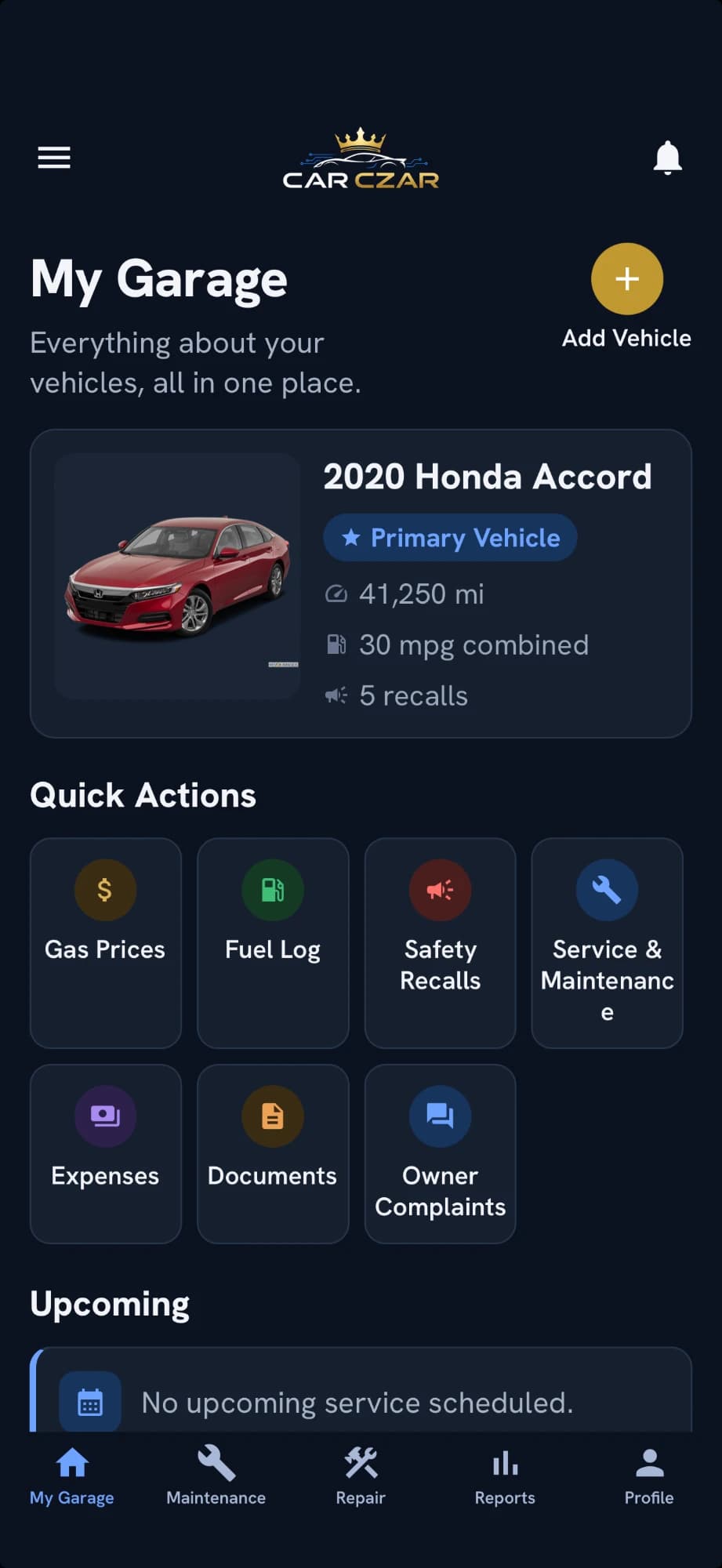
Car Czar is being built so that kind of change sits with the rest of the vehicle record: maintenance, repairs, reminders and what has already been done.
Your car shouldn’t have secrets.
Know when something important changes with your car.
Car Czar brings your maintenance, repairs, expenses, reminders and service records together in one place — so you know what's been done, what's coming next and what your vehicle is costing you.
Free to join • No credit card • Built for any vehicle
Sources
National Highway Traffic Safety Administration. NHTSA 2025 Annual Report: Safety Recalls. Published March 2026. Tables: “Number of Recalled Vehicles Remedied by Over-the-Air (OTA) Updates, by Recall Year and Light Vehicle Manufacturer (2021–2025),” “Number of Electric Vehicle Recalls and Electric Vehicles Recalled, by Recall Year (2021–2025)” and “Timing for Recall Remedy Availability (2021–2025).” https://www.nhtsa.gov/sites/nhtsa.gov/files/2026-03/2025-annual-recalls-report.pdf
National Highway Traffic Safety Administration. Check for Recalls: Vehicle, Car Seat, Tire, Equipment. https://www.nhtsa.gov/recalls