
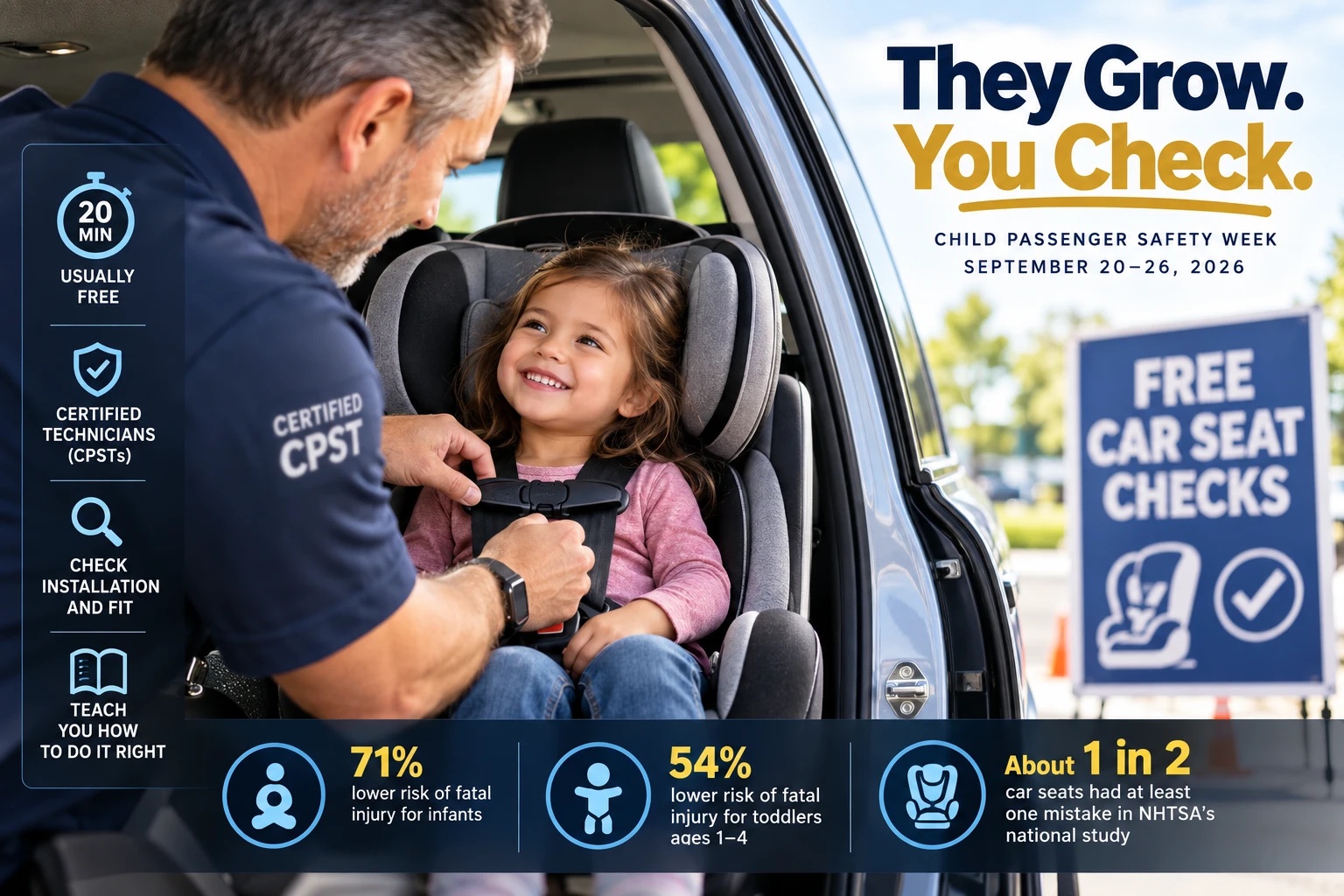
Most parents buckle their kids in every single trip. Far fewer have had anyone check whether the seat itself is installed and adjusted correctly — and that is where the problems hide.
This week is Child Passenger Safety Week (September 20–26, 2026), and it ends with National Seat Check Saturday on September 26, when certified technicians across the country hold free car seat checks. NHTSA and the Ad Council launched a new campaign this week built around a simple line: They Grow. You Check. (Ad Council / NHTSA)
Here is why a check is worth twenty minutes of your Saturday, what happens when you get one, and how to find a station near you.
Why the right seat, installed right, matters
Used correctly, child safety seats reduce the risk of fatal injury in passenger cars by 71% for infants and 54% for toddlers ages 1–4, according to NHTSA. (NHTSA, Children: 2024 Data)
The stakes are real. In 2024, 677 children age 14 and under were killed riding in passenger vehicles in the U.S. Among those whose restraint use was known, 39% were not restrained at all. (NHTSA)
But being buckled in is not the same as being buckled in correctly. NHTSA's roadside observations find about 92% of children under 8 are restrained. (NHTSA NOPUS, 2025) Yet when NHTSA had technicians inspect seats in more than 4,000 vehicles nationwide, about 46% had at least one mistake that could reduce protection in a crash — and for forward-facing seats it was 61%. That study's fieldwork was done in 2011, but it remains the most recent nationally representative look at car seat misuse. (NHTSA National Child Restraint Use Special Study)
In other words: in NHTSA's national study, roughly one in two seats had something wrong with it — and most parents have no way to tell by looking.
What happens at a car seat check
Checks are done by certified Child Passenger Safety Technicians (CPSTs) — often at fire departments, hospitals, police departments, and Safe Kids coalitions. A check typically takes 20–30 minutes. The technician looks at how the seat is installed and how your child fits in it, and — just as important — teaches you to install it correctly yourself, so you can get it right the next time you move it. (Safe Kids Worldwide)
Checks are usually free. NHTSA describes them as free "in most cases," so it is worth confirming when you call. Many stations work by appointment and hours change, so always call ahead.
One thing that trips people up: you may see figures like $95 or $55 online. Those are what technicians pay to get and stay certified — not what parents pay for a check. (National CPS Certification)
How to find a car seat check near you
- In Car Czar: open Car seat checks for NHTSA's published list of inspection stations in your state, with directions, phone numbers, and the year NHTSA last confirmed each listing. It takes a free Car Czar account. On the web it's linked from your Profile; in the app, open the ☰ menu and tap Car Seat Checks.
- NHTSA: the official campaign page at NHTSA.gov/TheRightSeat links to NHTSA's inspection finder and its Car Seat Finder for choosing the right seat by age and size.
- Safe Kids: find a technician by location, language, or special needs, or browse inspection stations by state.
NHTSA's list is not exhaustive, and some listings are years old — the "last confirmed" date is your cue to phone before you drive over.
Five checks you can do tonight
These don't replace a technician, but they catch the most common problems. Your car seat's manual and your vehicle's owner's manual always win where they differ. (American Academy of Pediatrics)
- The inch test. Grip the seat where the seat belt or LATCH strap passes through it. If it moves more than 1 inch side to side or front to back, it's too loose.
- The pinch test. With your child buckled in, try to pinch the harness strap at the shoulder. If you can pinch a fold of webbing, it's too loose.
- Chest clip at armpit level. Not down on the belly, not up at the neck.
- No puffy coats under the harness. A bulky coat compresses in a crash and leaves the harness loose. Buckle in with thin layers, then put the coat or a blanket over the top.
- LATCH or the seat belt — usually not both. Both are equally safe when used correctly; use two only if both the car seat and vehicle manufacturers say it's OK. For a forward-facing seat, always use the top tether when it's allowed.
And one absolute rule: never put a rear-facing seat in front of an active front passenger airbag.
They grow. Is it still the right seat?
The right seat depends on your child's height and weight today, not their age or last year's fit. The American Academy of Pediatrics' guidance is to delay every transition as long as the current seat's limits allow, because each step down gives up some protection: (AAP, CDC)
- Rear-facing for as long as possible, up to the seat's height and weight limits. Feet touching the vehicle seat back is common and is not a reason to turn them around.
- Forward-facing with a harness and top tether once they outgrow rear-facing — the CDC says until at least age 5.
- Booster seat until the adult seat belt fits properly — often around 4'9" and somewhere between ages 8 and 12. A booster needs a lap and shoulder belt, never a lap belt alone.
- Back seat until age 13.
A seat belt fits when the lap belt sits low across the upper thighs (not the belly) and the shoulder belt crosses the middle of the chest and shoulder (not the neck, and never under the arm or behind the back).
Seats to replace — or never use
- Expired seats. Car seats have a useful life. Check the manufacture date label and the manufacturer's recommended lifespan.
- Used seats with an unknown history, or any seat with cracks, missing parts, missing instructions, or missing labels. The labels carry the model number and manufacture date you need for recalls.
- Seats after a crash. NHTSA says to replace a seat after a moderate or severe crash. After a minor one it may not need replacing — but follow your seat manufacturer's instructions, as some say to replace after any crash. (NHTSA)
- Recalled seats. Register your seat with the manufacturer so you're told about recalls, or check with NHTSA at 888-327-4236.
- Aftermarket add-ons — inserts, padding, or products that claim to improve how a seat or belt fits, unless they came with the seat or its manufacturer approves them. They aren't covered by federal safety standards, and the AAP recommends against them.
The bottom line
Three things keep a child protected: the right seat for their size today, installed tight at the belt path, with a snug harness or a correctly routed belt. You can check some of that yourself tonight — but a certified technician will catch what you can't see, and it usually costs nothing.
This Saturday is the easiest day of the year to get it done. Find a car seat check near you →
Sources and further reading
- NHTSA, Children: 2024 Data (DOT HS 813 811, June 2026) — 2024 child fatality and injury counts, restraint use among children killed, and the 71% / 54% fatal-injury reduction estimates (which NHTSA draws from Hertz, Revised Estimates of Child Restraint Effectiveness, DOT HS 96 855, 1996). crashstats.nhtsa.dot.gov
- NHTSA, Results of the National Child Restraint Use Special Study (DOT HS 812 142, May 2015; fieldwork 2011) — misuse observed in 4,167 vehicles: 46% overall, 61% of forward-facing seats. crashstats.nhtsa.dot.gov
- NHTSA, National Occupant Protection Use Survey, Controlled Intersection Study, 2025 (DOT HS 813 820) — observed restraint use of 92.5% for children from birth to age 7. crashstats.nhtsa.dot.gov
- Ad Council and NHTSA — campaign announcement via PR Newswire (September 22, 2026): They Grow. You Check., Child Passenger Safety Week, and National Seat Check Saturday. prnewswire.com
- NHTSA, The Right Seat — Car Seat Finder and car seat inspection finder. nhtsa.gov/TheRightSeat
- NHTSA, Car Seat Use After a Crash — when to replace a seat after a minor, moderate, or severe crash. nhtsa.gov
- American Academy of Pediatrics, Child Passenger Safety (policy statement, Pediatrics, 2018) — delaying each transition, booster use until the belt fits, rear seat until 13. publications.aap.org
- HealthyChildren.org (AAP), Car Seats: Information for Families (updated April 16, 2026) — the inch and pinch tests, chest clip and harness position, coats, LATCH versus seat belt, used and expired seats, aftermarket products. healthychildren.org
- CDC, Child Passenger Safety — car seat stages by age and size. cdc.gov
- Safe Kids Worldwide, Get Your Car Seat Checked — what a check involves, and finding a certified technician. cert.safekids.org; inspection stations by state: safekids.org
- National Child Passenger Safety Certification, Fees — technician certification and recertification fees. cert.safekids.org
This article is general safety information, not a substitute for your car seat's instructions, your vehicle owner's manual, or a certified Child Passenger Safety Technician. Sources accessed September 24, 2026.