Your Monthly Car Payment Doesn't Tell You the Total Cost
Your car payment is the number you see every month, so it is easy to treat it as "what the car costs." It isn't. The total cost of car ownership also includes fuel, insurance, maintenance, taxes and fees, interest, and the value the car loses over time. In AAA's 2026 study, those costs averaged $12,863 a year for a new vehicle, or $1,071.92 a month.[1]
This guide separates two questions that often get mixed together: how much cash leaves your account each month, and what the car really costs you to own.
Two different questions: cash flow vs. total cost
Cash flow is the money you actually pay out: your down payment, your monthly loan payments, and your running costs like fuel and insurance. It is what you budget for.
Total cost of ownership is what the car costs you over the time you own it, once you get some of your money back by selling it. It counts:
Depreciation: the value the car loses between purchase and sale.
Interest: what you pay to borrow.
Running costs: fuel or charging, insurance, maintenance and repairs, taxes and fees.
Both views are useful. The mistake is mixing them.
What goes into the total cost of car ownership
AAA's 2026 Your Driving Costs analysis breaks the average new-vehicle cost into six categories. Depreciation was the largest at $4,422 a year.[1] Insurance averaged $2,098, finance charges $1,184, and license, registration and taxes $802 a year.[2] Fuel averaged 17.3 cents a mile and maintenance, repairs and tires 11.7 cents a mile, which at 15,000 miles a year comes to about $2,595 and $1,755.[2]
Where the average new car's cost goes
AAA 2026 Your Driving Costs, average annual cost per category.
Depreciation$4,422
Fuel$2,595
Insurance$2,098
Maintenance, repairs and tires$1,755
Finance charges$1,184
License, registration and taxes$802
New vehicles over five years and 75,000 miles. Fuel and maintenance converted from AAA's cents-per-mile at 15,000 miles a year. Source: AAA.[1][2]
Notice what is missing from that list: the loan payment itself. AAA counts the interest (finance charges) and the value lost (depreciation), not the full payment. That is the right way to add up ownership cost, and the next example shows why.
Remember the study's assumptions: new vehicles, five years and 75,000 miles, averaged across 34 top-selling models.[3] Your numbers will differ.
A worked example: $673 a month vs. $897 a month
Your car's history. All in one place.
Maintenance
Service Records
Expenses
Reminders
Know what's been done, what's coming next, and how much your car is costing you.
Free to join • No credit card • Built for any vehicle
This is a hypothetical example. It uses the same car as our guide to what car depreciation is: bought for $40,000 and sold after five years for $22,000.
Say you put $6,000 down and finance $34,000 for 60 months at 7% APR. Your payment is about $673 a month, and over five years you pay about $6,394 in interest.
Now add hypothetical running costs over the same five years: $10,200 for fuel, $9,000 for insurance, $7,200 for maintenance and repairs, and $3,000 for taxes and fees.
What this car really costs per month
Hypothetical example: $40,000 car, five years of ownership, monthly average.
Depreciation$300
Fuel$170
Insurance$150
Maintenance and repairs$120
Interest$107
Taxes and fees$50
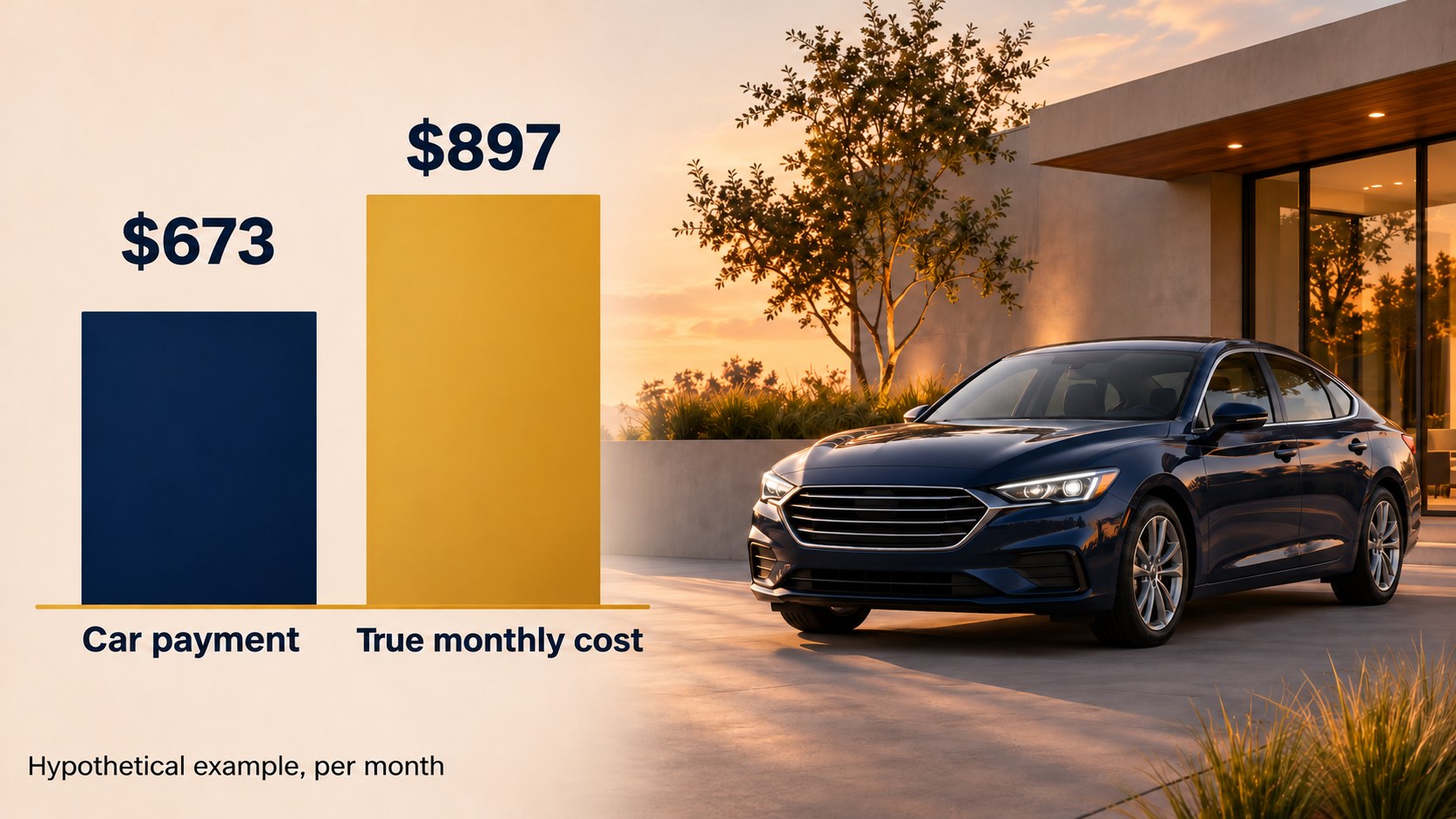
Total: about $897 a month, against a $673 loan payment. Loan principal is not a cost here; see below. Hypothetical example, not a forecast for any vehicle.
Over five years that adds up to $53,794. The payment is $673. The car really costs about $897 a month to own. The payment both leaves things out (fuel, insurance, upkeep) and includes something that isn't a cost at all, which is the next point.
Why you shouldn't add loan payments to depreciation
Here is a common mistake: adding up your loan payments, then adding depreciation on top.
Each payment has two parts. Interest is a real cost of borrowing. Principal pays down the loan, and it is really you paying for the car itself. Depreciation is the part of the car's price you won't get back when you sell.
So the car's price is already in your payments. If you add depreciation as well, you count the same dollars twice. In the example, that mistake would put the five-year cost near $94,000 instead of $53,794.
You can check this with the cash-flow view. Over five years you pay out $75,794: the $6,000 down payment, $40,394 in loan payments, and $29,400 in running costs. When you sell, you get $22,000 back. $75,794 minus $22,000 is $53,794, the same total cost.
How to use this before your next purchase
Budget with cash flow. Make sure the down payment, the monthly payment and the running costs fit your income.
Compare cars with total cost. Two cars with the same payment can cost very different amounts to own, once you count fuel, insurance, interest and how fast each one loses value.
Keep the two separate. Count depreciation plus interest plus running costs, or count everything you pay out minus what you get back. Never add full loan payments to depreciation.
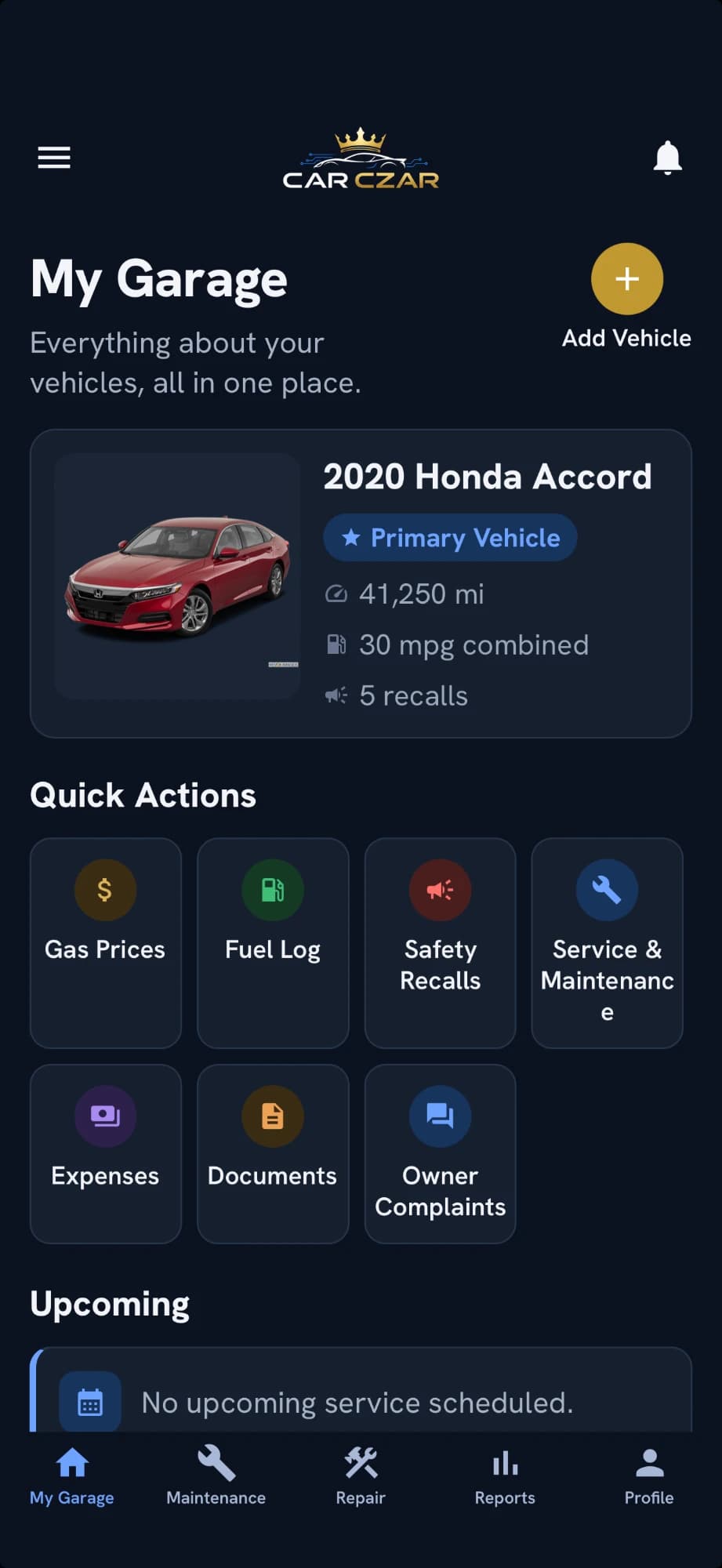
Car Czar keeps track of what you actually spend on a car, including fuel, service and repairs, so the running-cost side of this picture comes from real numbers instead of guesses. Learn more in our car management app guide.
Frequently asked questions
Is a lower monthly payment always cheaper?
No. Stretching the same loan over more months lowers the payment, but you pay interest for longer, so the total interest goes up. The car also loses value on the same schedule no matter how you pay for it.
If I pay cash, does the car cost less?
You avoid interest, so the total cost is lower by that amount. But depreciation, fuel, insurance and upkeep stay the same. A car bought with cash still loses value.
Should my down payment count as a cost?
Not on its own. The down payment is part of paying for the car, like the principal in your loan payments. What counts as cost is the value the car loses, plus interest and running costs.
The takeaway
Your car payment is a budgeting number, not the cost of owning the car. To see the total cost of car ownership, add depreciation, interest, fuel, insurance, maintenance and fees, and leave the loan principal out. In our example that turned a $673 payment into about $897 a month.
See what your car is really costing you.
Car Czar brings your maintenance, repairs, expenses, reminders and service records together in one place — so you know what's been done, what's coming next and what your vehicle is costing you.
Free to join • No credit card • Built for any vehicle
Footnotes / Sources
[1] AAA. AAA: New Vehicle Ownership Costs Top $12,000 Annually. Press release, September 15, 2026. https://mwg.aaa.com/news/press-release/september-15-2026
[2] CarPro. AAA Study: New Vehicle Ownership Is Up to $12,863 Per Year (category averages from AAA's 2026 Your Driving Costs study). September 2026. https://www.carpro.com/blog/aaa-study-new-vehicle-ownership-is-up-to-12863-per-year
[3] AAA Newsroom. AAA: New Vehicle Ownership Costs Hit $12,863 Annually, methodology section, as republished by EVSHIFT. September 2026. AAA's full methodology is in its 2026 Your Driving Costs fact sheet. https://www.evshift.com/526404/aaa-new-vehicle-ownership-costs-hit-12863-annually-aaa-newsroom/