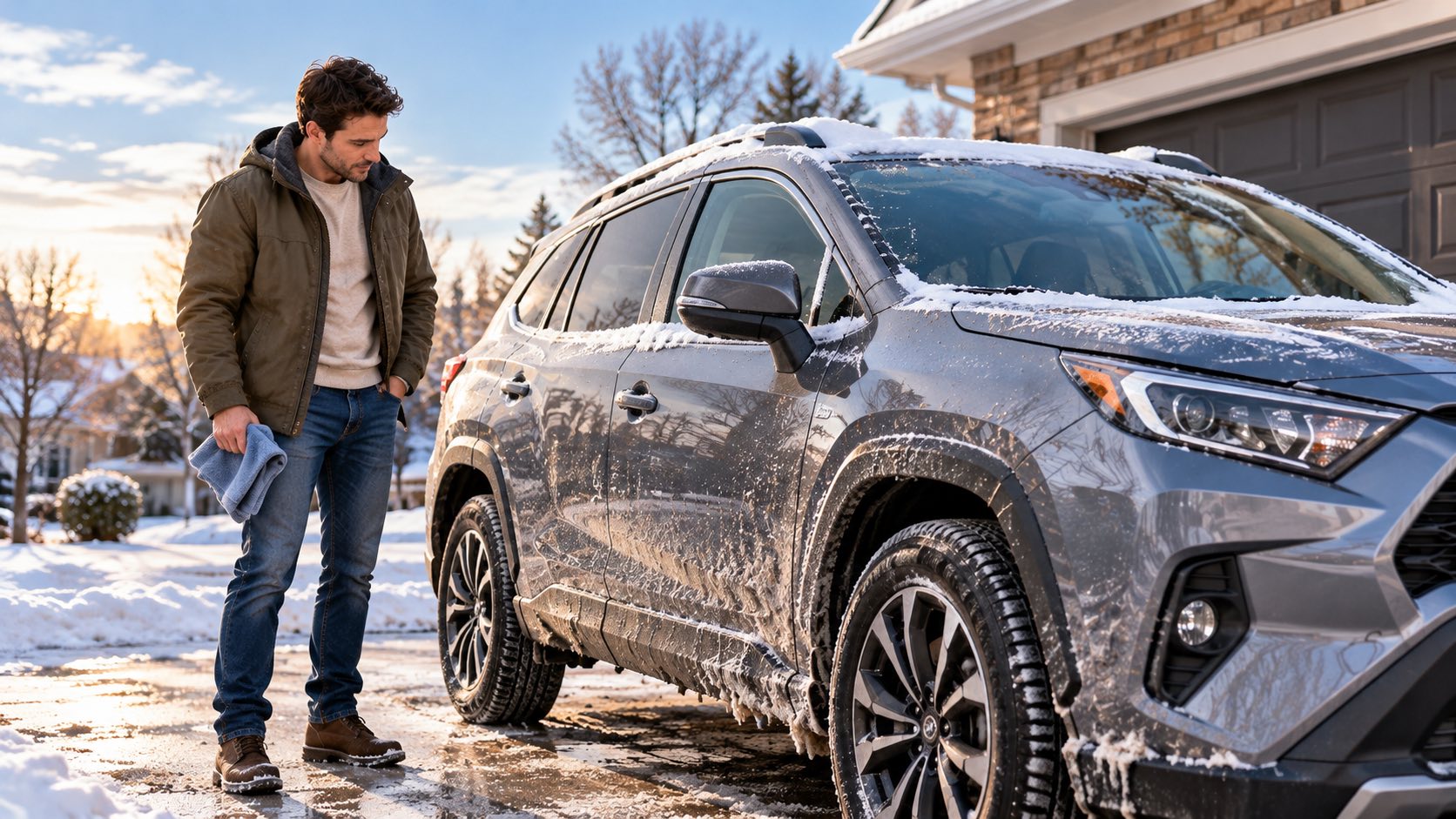
Before you reach for the towel: rinse the salt and grit away first, then dry.
Your car’s winter routine starts before the snow falls, and most of the damage comes from small habits rather than one bad storm. Road salt and de-icers cost U.S. drivers an estimated $15.4 billion in rust repairs over five years, according to a 2016 AAA survey, at an average of $490 per repair.[1]
Here are five habits worth changing, and what AAA and automakers’ own owner’s manuals recommend instead. If you have not prepped your car yet, start with how to prepare your car’s exterior for winter.
1. Waiting until spring to wash
Salt and grime build up all winter, and they keep working on the metal while they sit there. AAA recommends washing the entire vehicle frequently through the winter, including the undercarriage, with a detergent made for cars rather than dish soap.[1]
Owner’s manuals put a number on it. Hyundai and Kia both say to wash at least once a month, and to hose off the underside at least once a month in winter if you live where roads are salted.[2][3] After driving on treated roads, sooner is better.
2. Wiping a dirty car with a dry towel
It is tempting to wipe off a dusty, salt-streaked panel with whatever towel is in the trunk. Kia’s owner’s manual is blunt about it: “Wiping dust or dirt off the body with a dry cloth will scratch the finish.”[3] Hyundai gives the same warning.[2]
Rinse loose grit away before anything touches the paint. Those fine scratches matter more than they look: both manuals say chips and deep scratches should be repaired promptly, because exposed metal rusts quickly and “may develop into a major repair expense.”[2][3]
3. Applying protection over dirt
Your car's history. All in one place.
Maintenance
Service Records
Expenses
Reminders
Know what's been done, what's coming next, and how much your car is costing you.
Free to join • No credit card • Built for any vehicle
Wax and sealant only protect paint they can bond to. Hyundai and Kia both say: “Always wash and dry the vehicle before waxing,” then follow the product’s instructions.[2][3] Wax applied over grime seals the grime in.
AAA recommends a good coat of wax before winter.[1] Hyundai’s rule of thumb for when to re-apply is simple: wax again when water no longer beads on the paint.[2]
4. Forgetting the lower half
The hood and roof are what you see. The damage happens lower down, where road spray hits hardest.
Hyundai’s manual says to flush the underbody and wheel openings once a month and at the end of each winter, and warns that the drain holes along the lower edges of the doors, rocker panels and frame members must not clog, because trapped water there may cause rust.[2] It also notes that “just dampening the accumulated mud rather than washing it away may accelerate corrosion.”[2] Kia adds that wheels should be cleaned after driving on salted roads.[3]
Kia’s manual also repeats NHTSA’s advice to owners of every brand: wash the undercarriage regularly in winter, do a thorough undercarriage wash at the end of winter, and have the vehicle inspected for corrosion once a year.[3]
5. Treating protection as a one-time job
A protected car still needs care. Wax wears, and spot cleaners strip it: both manuals say to re-wax any area you have treated with a tar or spot remover, even if the rest of the car does not need it yet.[2][3]
Keep washing through the season, and finish it properly. AAA recommends one last undercarriage cleaning in the spring, because deposits left from winter can keep causing corrosion year-round.[1]
One more: the warm garage
Pulling a wet, snow-covered car into a warm garage feels like the kind thing to do. Hyundai and Kia both warn that a damp, poorly ventilated garage creates “a favorable environment for corrosion,” particularly when the car goes in wet or covered with snow, ice or mud. Even a heated garage can contribute unless it is well ventilated.[2][3]
Why the habits matter when you sell
Buyers and appraisers notice rust and paint damage. In Kelley Blue Book’s condition grades, a car in Excellent or Very Good condition is “free of rust,” while Fair “may have some repairable rust damage.” The same grades also weigh records, from “complete and verifiable service records” at Excellent down to “a few” at Fair.[4]
A winter of good habits is easy to forget by the time you sell. Car Czar is being built to keep maintenance, repairs, reminders and receipts in one place, so a monthly underbody rinse or a spring undercarriage wash can be a reminder, then part of a record you can show.
Your car shouldn’t have secrets.
Never miss important maintenance again.
Car Czar brings your maintenance, repairs, expenses, reminders and service records together in one place — so you know what's been done, what's coming next and what your vehicle is costing you.
Free to join • No credit card • Built for any vehicle
Sources
AAA. Road De-Icers and Rust Damage Fact Sheet. February 2017. Survey of 1,001 U.S. drivers, September 22–25, 2016. https://newsroom.aaa.com/wp-content/uploads/2017/02/Road-De-icers-and-Rust-Damage-Fact-Sheet-FINAL.pdf
Kelley Blue Book, Cox Automotive. Kelley Blue Book InfoDriver Display Requirements, vehicle condition definitions. January 2024. https://b2b.kbb.com/wp-content/uploads/sites/4/2024/01/Kelley-Blue-Book-INFODRIVER-Display-Requirements.pdf