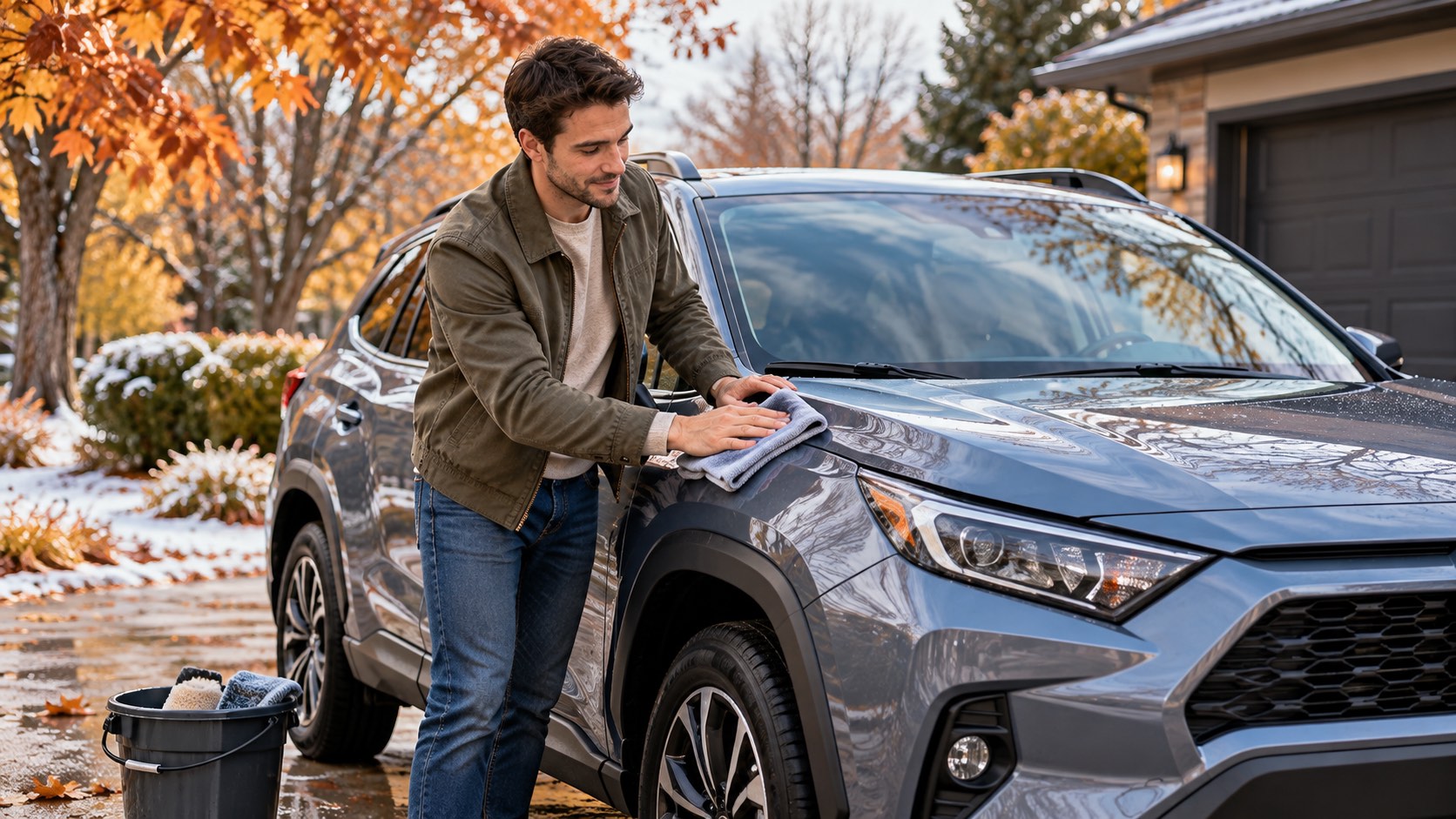
A clean, protected finish before the first storm makes the rest of winter easier.
Cold weather, road grime and salty slush are hard on a car’s exterior. The damage is slow and easy to ignore, until it shows up as rust.
In a AAA survey, 15% of drivers living in winter-climate regions said they had needed at least one repair for rust caused by road salt and de-icers in the previous five years. AAA put the total at $15.4 billion over those five years, more than $3 billion a year, at an average of $490 per repair.[1] The survey was conducted in 2016, so read those figures as a sense of scale rather than today’s prices.
Rust is not only cosmetic. AAA warns that it can damage a vehicle’s brakes, fuel tank and exhaust system.[1] It also costs you when you sell, which is why this is worth an afternoon before the first storm.
5 steps to prepare your car’s exterior for winter
1. Start with a thorough wash
AAA’s first recommendation is to wash and clean the car thoroughly before winter.[1] Rinse off loose grit before you touch the paint, then wash with a detergent made for vehicles. AAA specifically says not to use dish soap.[1]
Give the lower doors, wheel arches and wheels extra attention, since that is where road spray collects. Dry the car with clean microfiber towels.
2. Check for paint damage
With the car clean, walk around it in good light. Look for chips, scratches and exposed metal, especially along the front of the hood and the lower panels.
AAA recommends repairing body damage and touching up scratches and chips where bare metal is exposed.[1] A small chip is a quick fix in the fall. Left open through a salty winter, it can become a rust spot.
Your car's history. All in one place.
Maintenance
Service Records
Expenses
Reminders
Know what's been done, what's coming next, and how much your car is costing you.
Free to join • No credit card • Built for any vehicle
3. Add paint protection
AAA recommends a good coat of wax to protect the finish.[1] Whether you use a wax or a sealant, follow the product’s directions for surface preparation, application temperature and curing time. Protection applied over dirt, or in the cold, may not bond properly.
Protection makes winter washing easier. It does not replace it.
4. Clean glass and exterior lights
Clean the windshield, windows, mirrors, headlights and taillights. NHTSA’s winter checklist says to check your headlights, brake lights, turn signals and emergency flashers, replace worn wiper blades, make sure the defrosters work, and fill the reservoir with winter washer fluid that contains de-icer, because a single snowstorm can use a lot of it.[2]
Preparation before winter only helps if the salt keeps coming off. AAA recommends washing the entire vehicle frequently during winter, including the undercarriage.[1] It also suggests limiting driving right before, during and after storms, when de-icing chemicals are at their highest concentrations.[1]
Wash when the water can drain and the car can dry without freezing, or use a professional wash with an underbody rinse. When spring arrives, AAA recommends one last undercarriage cleaning, because deposits left over from winter can keep causing corrosion year-round.[1]
Why this shows up when you sell
Kelley Blue Book’s condition grades make the link between rust and value explicit. A car in Excellent or Very Good condition is “free of rust.” Good allows “only minor cosmetic or no rust.” Fair “may have some repairable rust damage.”[3]
The same definitions also grade paperwork: Excellent calls for “complete and verifiable service records,” Good for “some service records,” and Fair for “a few.”[3] Buyers look for both. KBB’s used-car advice tells shoppers to check the underside for rust, especially in states that salt their roads.[4]
So winter care pays off twice: once in rust you never have to repair, and again in a car that is easier to price and easier to trust. For more on what records do for resale, see what your service records are actually worth.
Keep the proof
A wash, a touch-up or a fresh coat of wax leaves no trace on paper unless someone writes it down. Car Czar is being built to keep that history in one place: maintenance, repairs, reminders and the receipts behind them, so the care you put into your car is something you can show.
Your car shouldn’t have secrets.
Give your car a service history you actually control.
Car Czar brings your maintenance, repairs, expenses, reminders and service records together in one place — so you know what's been done, what's coming next and what your vehicle is costing you.
Free to join • No credit card • Built for any vehicle
Sources
AAA. Road De-Icers and Rust Damage Fact Sheet. February 2017. Survey of 1,001 U.S. drivers, September 22–25, 2016. https://newsroom.aaa.com/wp-content/uploads/2017/02/Road-De-icers-and-Rust-Damage-Fact-Sheet-FINAL.pdf
National Highway Traffic Safety Administration. Winter Weather Driving Tips. https://www.nhtsa.gov/winter-driving-tips
Kelley Blue Book, Cox Automotive. Kelley Blue Book InfoDriver Display Requirements, vehicle condition definitions. January 2024. https://b2b.kbb.com/wp-content/uploads/sites/4/2024/01/Kelley-Blue-Book-INFODRIVER-Display-Requirements.pdf
Kelley Blue Book. Buying Older, Used Cars in 2026. https://www.kbb.com/car-advice/used-car-shopping-insider-tip-whats-more-important-mileage-age/