What Is Car Depreciation? The Ownership Cost You Don't See
Car depreciation is the value your car loses between the day you buy it and the day you sell or trade it in. It never arrives as a bill, so it is easy to leave out of your budget. Yet in AAA's 2026 study of new-vehicle ownership costs, it was the single largest cost of owning a car, larger than fuel, insurance or financing.[1]
This guide explains what car depreciation is, how to calculate it, and why it belongs in any honest answer to "what does my car cost me?"
What is car depreciation, in plain terms?
Depreciation is the decline in a vehicle's value over time. For a car you have already sold, the math is simple:
Depreciation = what you paid − what you got when you sold or traded it in
For a car you still own, it is an estimate: what you paid minus what the car is worth today. That "worth today" number is a market estimate, not a promise, and it can move with demand.
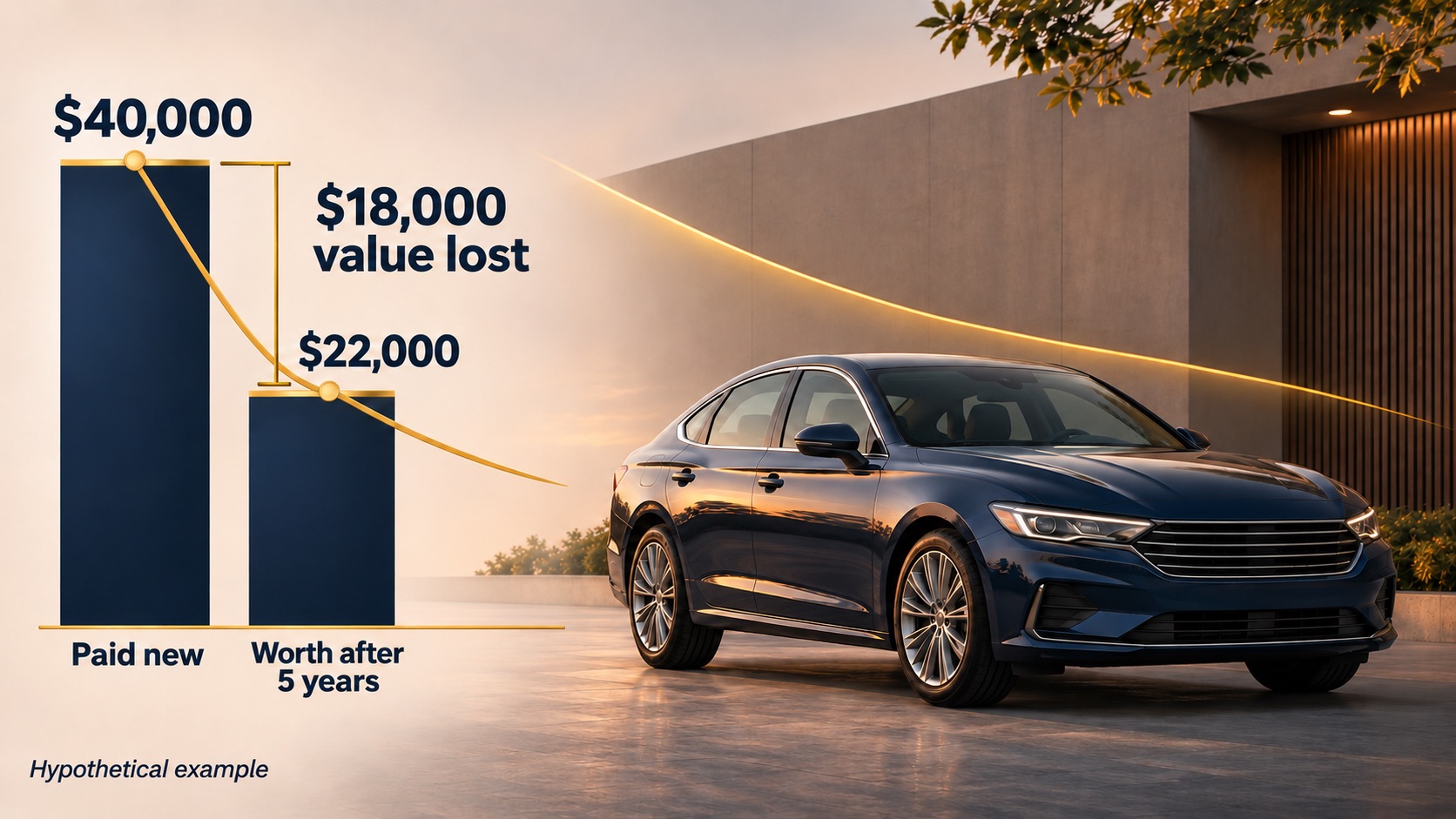
A worked example: where did $18,000 go?
Here is a hypothetical example to make the idea concrete.
Where $18,000 of value went
A hypothetical car bought new and sold five years later, in dollars.
Purchase price$40,000
Resale value$22,000
Value lost$18,000
Hypothetical example for illustration, not a forecast for any vehicle. Value lost is purchase price minus resale value.
Spread across 60 months, that $18,000 works out to an average of $300 a month.
Two cautions. First, this is an average, not a monthly bill: nobody sends you a $300 invoice. Second, the loss does not happen evenly. Cars typically lose value fastest in their early years, so a straight line from $40,000 down to $22,000 would be a simplification, not a forecast.
Why depreciation is the cost you don't see
Most car costs show up as money leaving your account: fuel, insurance, repairs, registration, loan payments. Depreciation is different. It is a loss in the value of something you own, and you only feel it when you sell, trade in, or have to replace the car.
That is why it is easy to overlook, and why it matters. When you eventually sell, the car will be worth less than you paid, and that gap is part of what owning the car cost you, even though you never paid it out month by month.
How big is depreciation? AAA's 2026 benchmark
AAA's 2026 Your Driving Costs analysis estimates that owning and operating a new vehicle costs an average of $12,863 a year, or $1,071.92 a month.[1] Depreciation was the biggest category: vehicles lost a weighted average of $4,422 a year in value from purchase price to resale.[1]
Your car's history. All in one place.
Maintenance
Service Records
Expenses
Reminders
Know what's been done, what's coming next, and how much your car is costing you.
Free to join • No credit card • Built for any vehicle
That is about 34% of the total, or a little more than a third.
Keep the study's assumptions in mind before applying it to your own car:
It models new vehicles over five years and 75,000 miles.[2]
It averages 34 top-selling models across seven vehicle categories, so your vehicle may lose more or less.[2]
AAA changed its methodology for 2026, so its results are not directly comparable with the prior year's estimate.[2]
Treat it as a dated benchmark that shows the scale of the cost, not as a quote for your car.
Depreciation is not your car payment
Depreciation often gets mixed up with loan payments, but they measure different things:
Depreciation is the value the car loses.
Loan principal is the part of your payment that reduces what you owe.
Interest is the cost of borrowing the money.
Your loan balance and your car's value move on separate paths. Paying down the loan does not slow depreciation, and paying cash does not prevent it. When you add up what a car costs to own, count depreciation and interest, plus fuel, insurance, maintenance, repairs, taxes and fees. Do not also add the full loan payments, or you will count the same dollars twice.
What affects how fast a car depreciates?
Kelley Blue Book lists mileage, age, reliability, number of owners, service history, desirability, fuel economy, warranty length and general condition among the main factors.[3]
Some of these are set the day you buy the car, such as the model and how much demand there is for it. Others are partly in your hands over time:
Mileage: how much you drive.
Condition: how well the car is kept, inside and out.
Service history: whether maintenance was done on schedule, and whether you can prove it.
Good maintenance supports a car's condition, but it cannot guarantee a higher resale price. The market still decides what buyers will pay.
How to keep depreciation in view
You cannot send depreciation a payment, but you can track it so it does not surprise you:
Write down what you paid and the date you bought the car.
Check an estimated value once in a while, noting the date and source, so you can see the gap.
Keep your service records together. They help the car's condition story when it is time to sell.
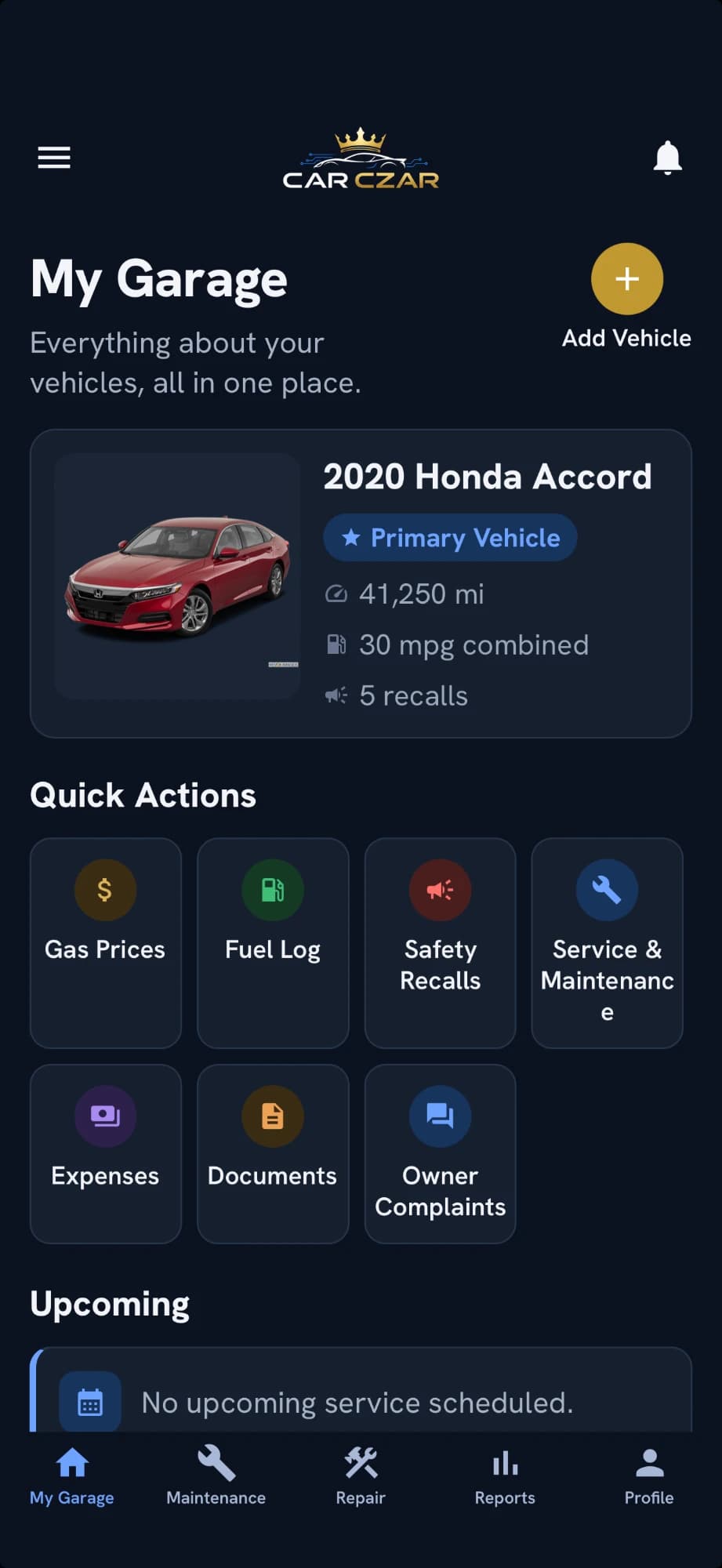
Car Czar keeps your vehicle's records in one place, including service history, receipts and costs, so the full picture of what a car costs you is easier to see. Learn more in our car management app guide.
Frequently asked questions
Does a paid-off car still depreciate?
Yes. Depreciation is about the car's value, not the loan. A paid-off car keeps losing value as it ages and adds miles, even though you no longer make payments on it.
Does depreciation happen at the same rate every year?
No. Cars typically lose value fastest early on, and the pace usually slows as they age. The $300-a-month figure in the example above is an average across five years, not the loss in any single month.
When does depreciation actually cost me money?
You realize the loss when you sell or trade in the car, because you receive less than you paid. Until then it is an on-paper loss, but it still belongs in your ownership cost when you compare cars or decide whether to keep one.
The takeaway
Depreciation is the car expense that never sends you a bill. It is the gap between what you pay and what the car is worth when you let it go, and in AAA's 2026 new-car study it was the largest single ownership cost.[1] Knowing your purchase price, checking your car's value now and then, and keeping good records will keep that gap from being a surprise.
Your car shouldn't have secrets, and neither should its costs.
See what your car is really costing you.
Car Czar brings your maintenance, repairs, expenses, reminders and service records together in one place — so you know what's been done, what's coming next and what your vehicle is costing you.
Free to join • No credit card • Built for any vehicle
Footnotes / Sources
[1] AAA. AAA: New Vehicle Ownership Costs Top $12,000 Annually. Press release, September 15, 2026. https://mwg.aaa.com/news/press-release/september-15-2026
[2] AAA Newsroom. AAA: New Vehicle Ownership Costs Hit $12,863 Annually, methodology section, as republished by EVSHIFT. September 2026. AAA's full methodology is in its 2026 Your Driving Costs fact sheet. https://www.evshift.com/526404/aaa-new-vehicle-ownership-costs-hit-12863-annually-aaa-newsroom/
[3] Kelley Blue Book. Car Depreciation. https://www.kbb.com/car-depreciation/