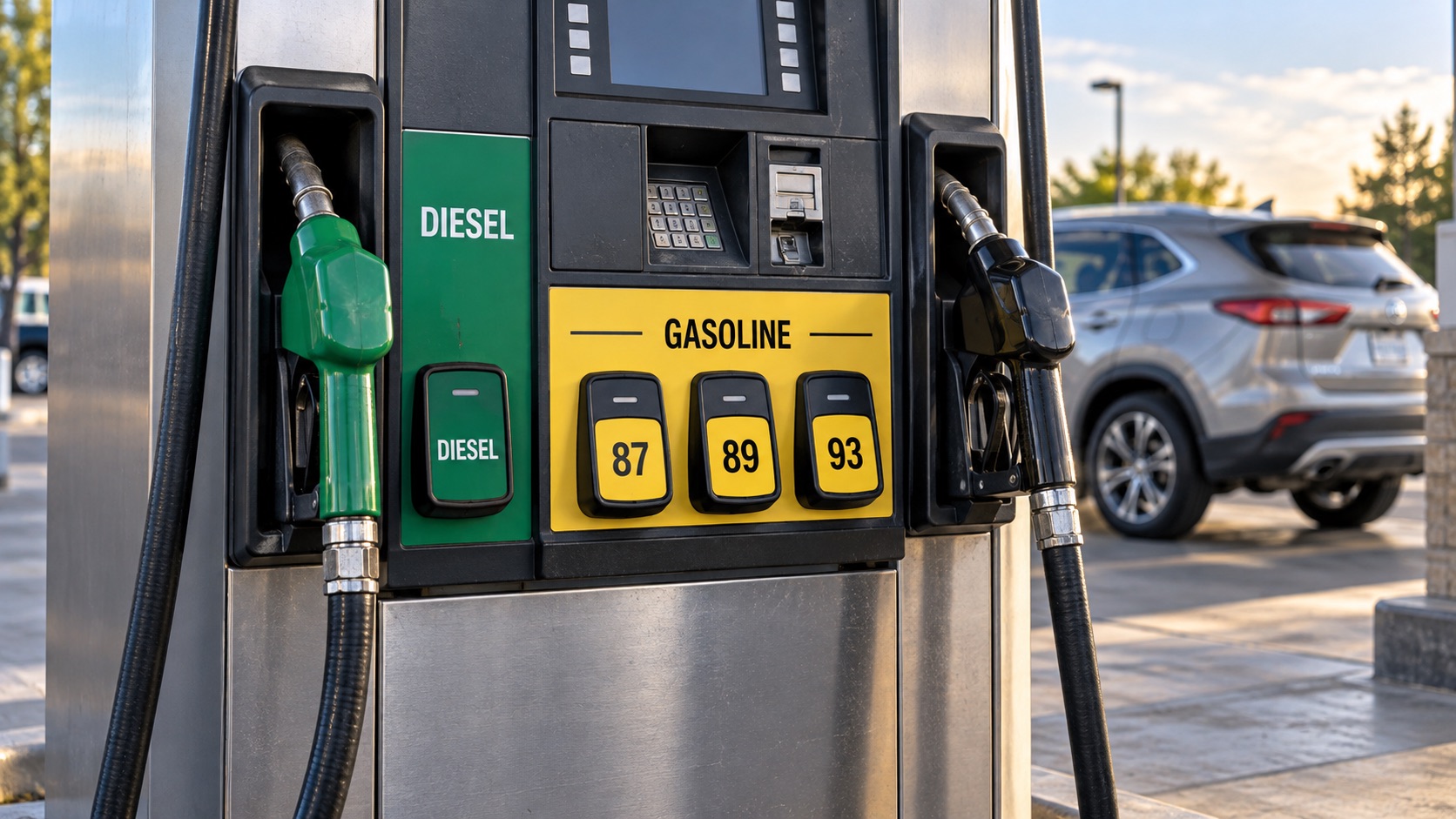
A row of fuel buttons can turn a routine fill-up into a guessing game. Is the expensive brand better? Will regular damage your engine? Does a slow pump mean something is wrong with the gas?
Start with your vehicle's fuel requirements. Then consider detergency, price and how you drive. Those are separate decisions.
What's the difference between gasoline brands?
Additive packages are a meaningful difference. U.S. gasoline must contain detergent additives, while marketers can use different packages and quality controls beyond minimum requirements. A higher price does not prove a fuel is better for your particular vehicle.[2]
Gasoline also changes with location, season and grade. Fuel formulations are not identical everywhere.[3] Blanket claims that every station sells identical gasoline miss those differences.
Why are there so many octane ratings?
Octane measures resistance to engine knock. Different engine designs need different levels, especially as cylinder pressure increases. In the U.S., unleaded gasoline is typically 87 (regular), 88–90 (midgrade), and 91–94 (premium). Some high-elevation areas sell 85. A larger number is not a universal promise of more power.[1]
Which octane should I use?
Check the fuel label and the manual for your exact engine and model year. Find the minimum permitted number and read any separate recommendation for best performance. A vehicle might permit regular but recommend premium. Another may require premium.[6]
Read the number rather than relying on a station's "super" or "premium" name. Even where 85 is sold at elevation, follow the manufacturer's specified fuel. Unless the vehicle is an older carbureted engine, 85 is not a safe substitute for the grade the manual names.[1]
What does TOP TIER mean?
TOP TIER is an automaker-backed fuel performance program focused on detergency. At licensed gasoline outlets, its standard applies across all octane grades. Regular can therefore be TOP TIER, too. Check the current approved list before you treat a logo on the pump as current.[4]
Choose octane for your engine's requirements and evaluate detergency separately. A gasoline approval also does not automatically cover that retailer's diesel. The programs are separate.[15]
Will lower octane hurt my engine?
Going below the required minimum can cause poor operation and can damage the engine and emissions system over time. It may also void the warranty. Many newer engines can adjust ignition timing to reduce knock, but engine power and fuel economy still suffer. That protection is not permission to ignore the minimum.[1]
Using regular that the manual explicitly permits is a different case. If you accidentally buy fuel below the minimum, follow the manual's instructions or contact the manufacturer for your vehicle. Light knock now and then is not the same thing. Ford's fuel-quality guidance says not to worry about occasional light knock, but if the engine knocks heavily under most driving conditions while you are using the recommended octane, see a dealer before it becomes engine damage.[16]
Will it hurt my MPG?
It can. The answer depends on the engine and conditions. AAA says 16.5 million U.S. drivers have used premium even though the manufacturer did not recommend it. In AAA's tests of vehicles designed for regular, premium brought no significant gain in horsepower, fuel economy or emissions.[5]
Where a manual recommends premium but still permits regular, AAA's tests with the Automobile Club of Southern California found modest fuel-economy and performance gains in extreme driving, such as towing, hauling and hard acceleration, and less benefit in ordinary city or highway driving.[5] Do not turn that into a promise that premium will pay for itself.
Compare cost per mile if both grades are permitted: price per gallon divided by measured MPG. As a hypothetical example, $3.50 at 30 MPG is 11.7 cents per mile; $4.10 at 31 MPG is 13.2 cents. A mileage improvement does not necessarily cover the price increase.
Will it hurt performance?
Permitted regular may deliver less power than recommended premium in an engine designed to take advantage of higher octane. The effect can be more relevant during towing, heat or hard acceleration. It is vehicle-specific, so do not assume a fixed horsepower loss.[6][5]
If your manual requires a higher grade, use it. If it allows a choice, weigh the manufacturer's guidance, your driving and the price difference.
Why do we have summer-blend gasoline?
Gasoline evaporates, and warm weather increases the importance of controlling those vapors. Summer standards limit volatility to reduce emissions that contribute to ground-level ozone, or smog. Requirements and dates vary by place. The seasonal switch is an air-quality measure, not a new octane grade.[7]
Does a slow pump mean I'm getting the bottom of the tank?
Pump speed alone cannot tell you that. A restricted dispenser filter can slow delivery. Hose restrictions and damaged nozzle components can also affect flow. Those are documented equipment causes, not a diagnosis of the station you are visiting.[8][9]
Tell the attendant when a pump runs unusually slowly. If you see a leak or spill, stop dispensing and alert staff. Leave equipment inspection to trained personnel.
How is diesel different?
Diesel fuel has its own specifications. Cetane relates to ignition quality, while gasoline octane addresses knock resistance. Follow your diesel manufacturer's requirements for fuel and permitted blends.[11]
U.S. highway diesel is ultra-low sulfur diesel, at 15 parts per million of sulfur or less. Most diesel sold for off-highway use is also ultra-low sulfur. That does not make every dyed product appropriate for your engine.[10]
When can I use off-road diesel?
Ordinarily, red-dyed diesel is intended for qualifying tax-exempt uses, such as eligible farm and off-highway business operations. Owning a farm or driving a pickup off pavement does not by itself establish permission for highway use.[12]
Dated update — checked November 2, 2026: The IRS announced temporary nationwide federal penalty relief for dyed diesel sold for use or used on highways from October 1 through December 31, 2026 (IR-2026-122). That relief is federal only. It does not override state fuel-tax or dyed-fuel rules, and the IRS has not yet announced a grace period for dye left in the tank after December 31. Check current IRS guidance and the relevant state revenue agencies before using dyed diesel on the road. Do not assume the exception continues beyond its stated period.[13][14]
Before your next fill-up
Find your vehicle's minimum octane or diesel specification, read the recommendation for best results, and save that information somewhere easy to reach. Compare prices only among fuels your vehicle permits.
The costly button is the one this car was never cleared to use, or the required grade you skipped because a cheaper one was closer. Keep the requirement with the car, and keep what you paid. Car Czar is built so a vehicle's records live in one place, and the next fill-up can start from those records instead of from memory.
Your car shouldn't have secrets.
Save this guide and share it with the person who always asks, "Which button should I press?"
Footnotes / Sources
[1] U.S. Department of Energy and U.S. Environmental Protection Agency. Selecting the Right Octane Fuel. fueleconomy.gov. Accessed November 2, 2026.
https://www.fueleconomy.gov/feg/octane.shtml
[2] Michigan Department of Agriculture and Rural Development. The Differences in Gasoline. Accessed November 2, 2026.
https://www.michigan.gov/mdard/lab/motor/the-differences-in-gasoline
[3] U.S. Energy Information Administration. Gasoline explained. Accessed November 2, 2026.
https://www.eia.gov/energyexplained/gasoline/
[4] TOP TIER. Approved Gasoline Brands. Accessed November 2, 2026.
https://www.toptiergas.com/gasoline-brands/
[5] AAA. Premium Fuel Research. Includes the finding that 16.5 million U.S. drivers have used premium despite the manufacturer's recommendation, laboratory tests of vehicles designed for regular, and Automobile Club of Southern California tests of vehicles that recommend but do not require premium. Accessed November 2, 2026.
https://gasprices.aaa.com/premium-fuel-research/
[6] Volkswagen. Understanding fuel types. Accessed November 2, 2026.
https://www.vw.com/en/newsroom/discover-vw/it-is-a-gas.html
[7] U.S. Environmental Protection Agency. Gasoline Reid Vapor Pressure. Accessed November 2, 2026.
https://www.epa.gov/gasoline-standards/gasoline-reid-vapor-pressure
[8] Franklin Electric. Flow Rate Monitoring. Accessed November 2, 2026.
https://www.franklinfueling.com/en/landing-pages/flow-rate-monitoring/
[9] OPW. 7H and 7HB nozzle troubleshooting instructions. Accessed November 2, 2026.
https://www.opwglobal.com/docs/libraries/retail-fueling/manuals/above-ground/7h_and_7hb_troubleshooting_instructions_-_english_h15891pae.pdf
[10] U.S. Energy Information Administration. Diesel fuel explained. Highway diesel is ultra-low sulfur diesel at 15 ppm sulfur or less; most non-road diesel is also ULSD. Accessed November 2, 2026.
https://www.eia.gov/energyexplained/diesel-fuel/
[11] U.S. Department of Energy, Alternative Fuels Data Center. Diesel Vehicles Using Biodiesel. Accessed November 2, 2026.
https://afdc.energy.gov/vehicles/diesel
[12] Internal Revenue Service. Publication 510, Excise Taxes. Accessed November 2, 2026.
https://www.irs.gov/publications/p510
[13] Internal Revenue Service. IRS provides dyed diesel fuel relief related to excise tax. IR-2026-122, October 14, 2026. Relief runs October 1 through December 31, 2026, and does not affect state fuel taxes.
https://www.irs.gov/newsroom/irs-provides-dyed-diesel-fuel-relief-related-to-excise-tax-following-president-trumps-executive-order
[14] Internal Revenue Service. Dyed diesel — Frequently asked questions. October 23, 2026. Federal relief does not address state dyed-fuel rules. A grace period for residual dye after the relief period is under consideration, not announced.
https://www.irs.gov/newsroom/dyed-diesel-frequently-asked-questions
[15] TOP TIER. Consumer frequently asked questions. Accessed November 2, 2026.
https://perform.toptiergas.com/consumer-frequently-asked-questions/
[16] Ford. Owner's Manual, "Fuel and Refueling — Fuel Quality," online edition. Light knock on the recommended octane is not a concern; heavy knock under most driving conditions means see an authorized dealer. The same page's octane notes cover specific engines, including a recommendation of 87 and premium for severe duty on some of them. Accessed November 2, 2026.
https://www.fordservicecontent.com/Ford_Content/vdirsnet/OwnerManual/Home/Content?ProcUid=G1642502&Uid=G1635324&buildtype=web&countryCode=USA&div=f&languageCode=en&userMarket=usa&vFilteringEnabled=False&variantid=4227