
Gas prices aren't something you control. Your tire pressure is — and it's one of the few levers that costs nothing and takes under a minute, yet roughly a quarter of drivers still skip it. NHTSA estimates about 1 in 4 vehicles on U.S. roads has at least one significantly underinflated tire, and every one of them is quietly burning extra gas every time it rolls.
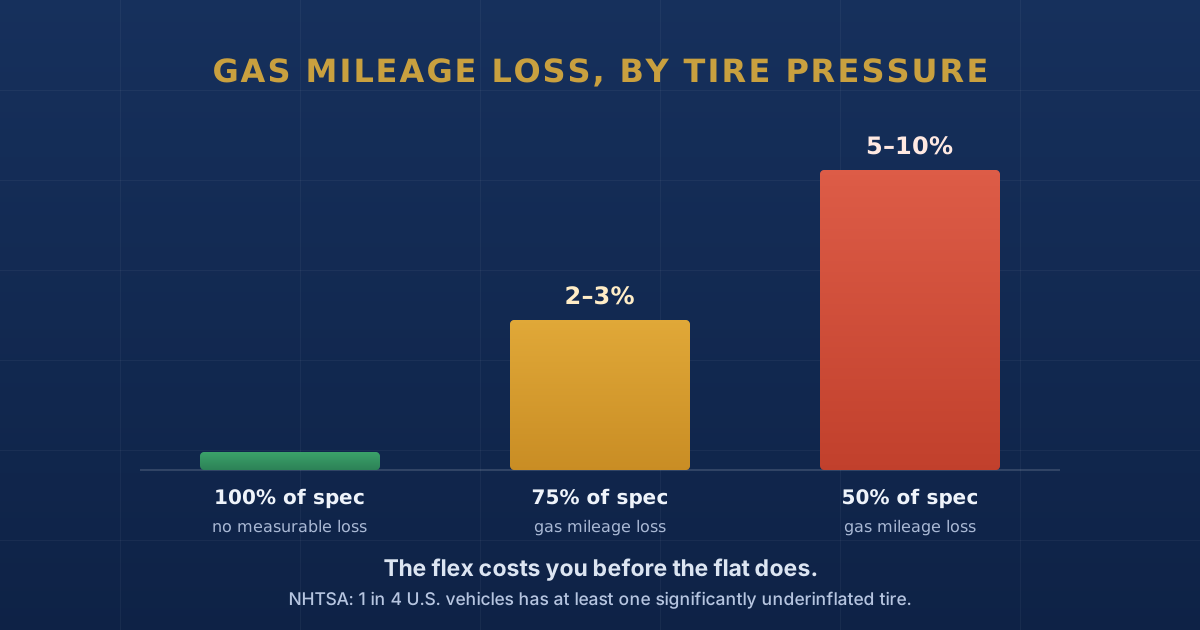
The loss isn't linear — it accelerates the further a tire falls below spec.
The mechanism is simple: an underinflated tire flexes more as it rolls. That flex is friction, and friction burns gas your engine has to make up — even driving in a straight line at a constant speed.
The numbers, from a few different angles
Estimates vary by source, but they all point the same direction:
| Source | Finding |
|---|---|
| DOE / FuelEconomy.gov | ~0.2% drop in gas mileage per 1 psi under-inflation, across all four tires |
| EPA / FuelEconomy.gov | ~0.3% drop in gas mileage per 1 psi under-inflation |
| AAA | Up to 2% loss in gas mileage per psi below the recommended level |
| DOE aggregate estimate | Properly inflated tires improve gas mileage by ~3.3% on average |
The effect isn't linear at the extremes. Tires at 75% of recommended pressure cost 2–3% in gas mileage; at 50% of recommended pressure, the loss climbs to 5–10%, depending on speed.
What that looks like in real money
A June 2025 Firestone Complete Auto Care analysis of 9.7 million serviced vehicles found 42% underinflated, averaging 13 psi below spec — and put the aggregate cost to U.S. drivers at roughly $18.6 billion a year in wasted gas. For a typical driver — 1,200 miles a month, 28 mpg, gas around $4.11/gallon — that worked out to about $55 a year from one underinflated set of tires. The DOE separately estimates 3.56 million gallons of gas wasted every day nationally from incorrectly inflated tires.
Why it's the easiest maintenance win there is
Unlike most items on a maintenance schedule, this one costs nothing — a gauge check takes under a minute, and most gas stations have free or roughly $1 air pumps. It isn't just about gas, either. Correct pressure also:
- Extends tire life. Uneven wear from under- or over-inflation is one of the most common causes of early tire replacement.
- Improves handling and braking distance.
- Reduces blowout risk, especially at highway speed in hot weather.
Check pressure monthly, cold, before driving — against the number on the sticker inside the driver's door jamb, not the number molded into the tire's sidewall. That sidewall number is the tire's maximum rating, not what your vehicle actually calls for, and using it is one of the most common reasons drivers end up overinflated instead.
Don't forget the spare. It's the one tire nobody checks — sitting at whatever pressure it had when the car left the factory, possibly years ago. A full-size spare should match your other tires' recommended pressure; a compact "donut" spare needs its own, higher psi, usually printed right on its sidewall. Either way, you don't want to find out it's flat while you're already on the shoulder.